
Colditz and Great Escape Tour: Walking the Real Ground
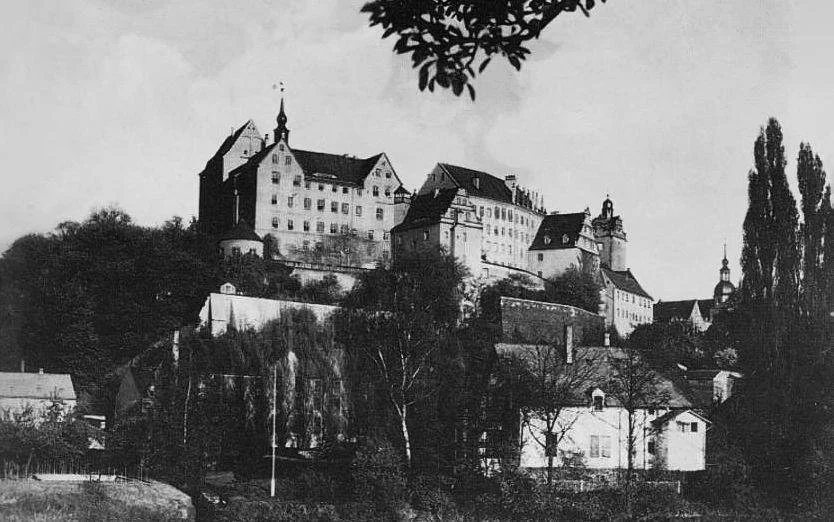
Colditz Castle in April 1945, shortly before the end of the Second World War.
Most of us met these places on a screen first: Steve McQueen on the motorbike, the tunnel called Harry, the roll-call that comes up fifty short. Then Colditz, the castle the Germans swore was escape-proof and the officers who spent four years proving otherwise.
The camps are still there. Stalag Luft III sits in a pine forest outside Żagań in western Poland, the tunnel line marked on the forest floor. Colditz Castle stands above the Mulde as it did in 1945, and you can walk the courtyard and the doorway Airey Neave walked out of in a homemade German uniform.
A Colditz and Great Escape tour puts the two together over four days, guided and driven, starting and finishing at whichever airport suits your group — Prague, Berlin, Dresden, Leipzig or Wrocław all work. It's the escape story told on the ground where it happened, in the order it happened: the mass breakout first, then the fortress where the persistent offenders were sent.
What the films got right, and what they didn't
Anyone who calls themselves a Second World War buff has watched The Great Escape and Where Eagles Dare. 1960s Hollywood can be a hard watch now: the special effects look dated, the tone is breezy, and the Allies-can-do-no-wrong flavour strips away the genuine grimness of a German prison camp. But The Great Escape gets far more right than it gets wrong.
The scale of the breakout was real. On the night of 24 March 1944, 76 Allied airmen made it out through Tunnel Harry. 73 were recaptured. Fifty of them were murdered by the Gestapo on direct orders from Berlin. Only three men made it back to Britain.
The engineering you see on screen was also accurate. The prisoners dug three tunnels simultaneously — named Tom, Dick and Harry, which remains about as British a piece of nomenclature as you will find. The air pumped through a duct of Klim powdered-milk tins, the bellows built from kit-bags, the bed-board shoring holding up the sandy Silesian soil: that was all true to life. It wasn't even the camp's first breakout. The Wooden Horse escape of October 1943 came from the East Compound — three men out through a tunnel dug under a vaulting horse.
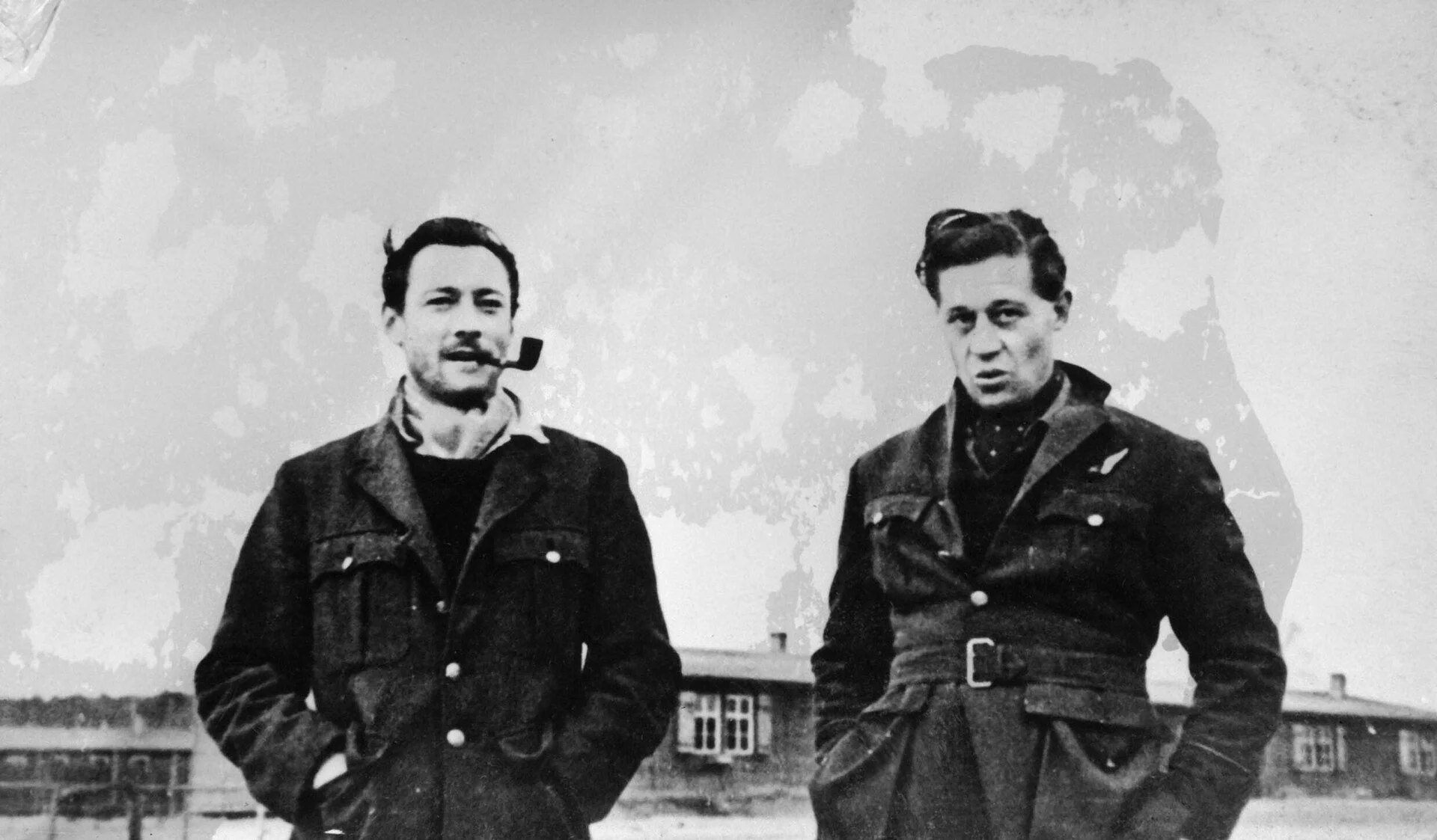
Squadron Leaders Robert Stanford Tuck and Roger Bushell at Stalag Luft III. Bushell, known as “Big X”, was the driving force behind the Great Escape. (Imperial War Museums, HU 1605 / Public Domain)
What the film gets wrong comes down to Hollywood. The motorcycle jump over the border wire never happened. There was not a single American in the tunnel on the night of the escape. The American officers had done their share of the digging, but the Luftwaffe transferred them to the newly opened South Compound months before Harry was completed. You forgive the film those liberties because the core technical achievement and the grim aftermath were handled with respect.
Where Eagles Dare is a completely different animal. It is pure entertainment, not history, and it was never set at Colditz or any other real prisoner-of-war camp. That is fine by me. The one detail I cannot forgive is the helicopter. There were no operational helicopters running mountain insertions behind German lines in 1944.
The route at a glance
Four days, a private vehicle for up to seven, one guide throughout. The two camp days are the fixed core; the first and last days bend to fit where you're flying from and where you're heading next.
Day 1 — Arrival. We meet you at your arrival airport or station — Prague, Berlin, Dresden, Leipzig or Wrocław — and drive to the first night's stop within easy reach of Żagań. Dinner and a briefing on what's ahead.
Day 2 — Stalag Luft III. The full day at the camp: the museum, the reconstructed hut, the marked line of Tunnel Harry from Hut 104 to the trees, and the station where the escapers caught their trains. Late afternoon we drive west for the night — Bautzen for the last battle of the war in the East, or Dresden for the easier evening.
Day 3 — Colditz. The castle in the morning, the Tiergarten and the walk out through the town in the afternoon. Overnight in Colditz — in the castle itself, if you want to.
Day 4 — Departure. Breakfast, then we drive you to your airport or station for the flight home, or on to wherever the trip goes next — Berlin, Prague, Dresden and Leipzig are all within a few hours.
Dates and pace are yours to set. Some groups add a day for Dresden or the Elbe crossing at Torgau; some want it tighter. Tell us what you have in mind and we'll build the itinerary around it.
Stalag Luft III — what's actually there
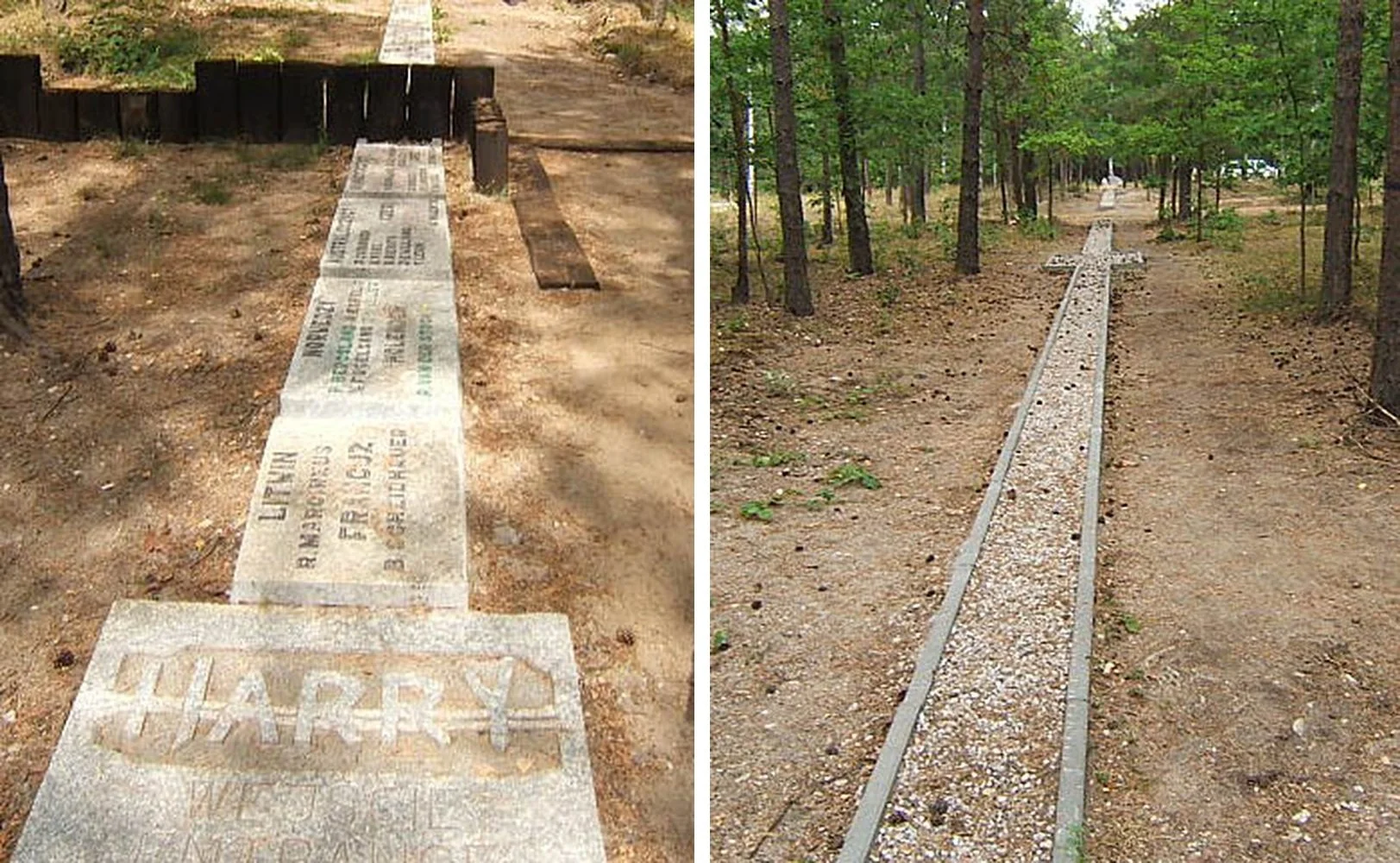
The marked route of Tunnel Harry through the former North Compound of Stalag Luft III.
When you get to Żagań today on a Great Escape tour, you find a site defined by quiet pine woods rather than barbed wire and guard towers. The modern Stalag Luft III site — Stalag Luft 3, if you're searching for it — requires you to read the ground. The camp layout is marked out among the trees, where the concrete footings of the barracks still sit in the earth. A reconstructed hut shows the scale of the living quarters, and the path of Harry is traced directly across the forest floor from the trapdoor location under the stove in Hut 104 out to the tree line where the tunnel broke the surface — short of the trees, which is why the whole thing unravelled.
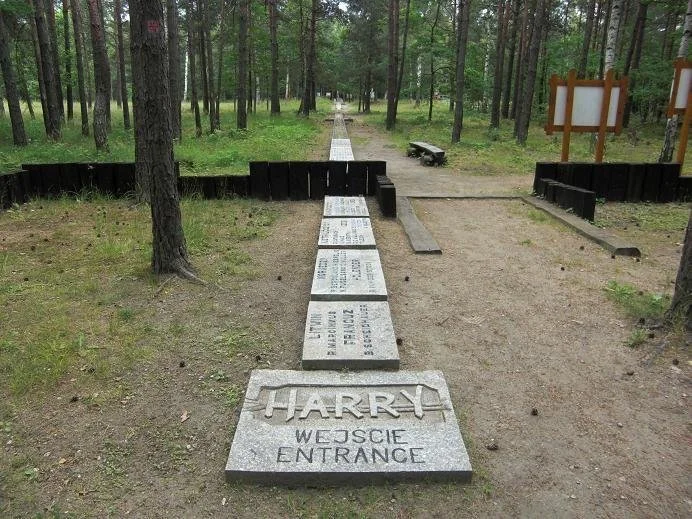
The marker at the end of Tunnel Harry. The tunnel emerged short of the cover of the trees. (Photo: Vorwerk / Wikimedia Commons, CC BY-SA/GFDL)
The memorial to the Fifty stands at the edge of the camp. The prisoners built it themselves. It is empty. The RAF found it broken into in 1948, the urns smashed by soldiers looking for gold, and the ashes of forty-eight of the fifty now lie in Poznań Old Garrison Cemetery. The memorial is where the story is told. The men are elsewhere.
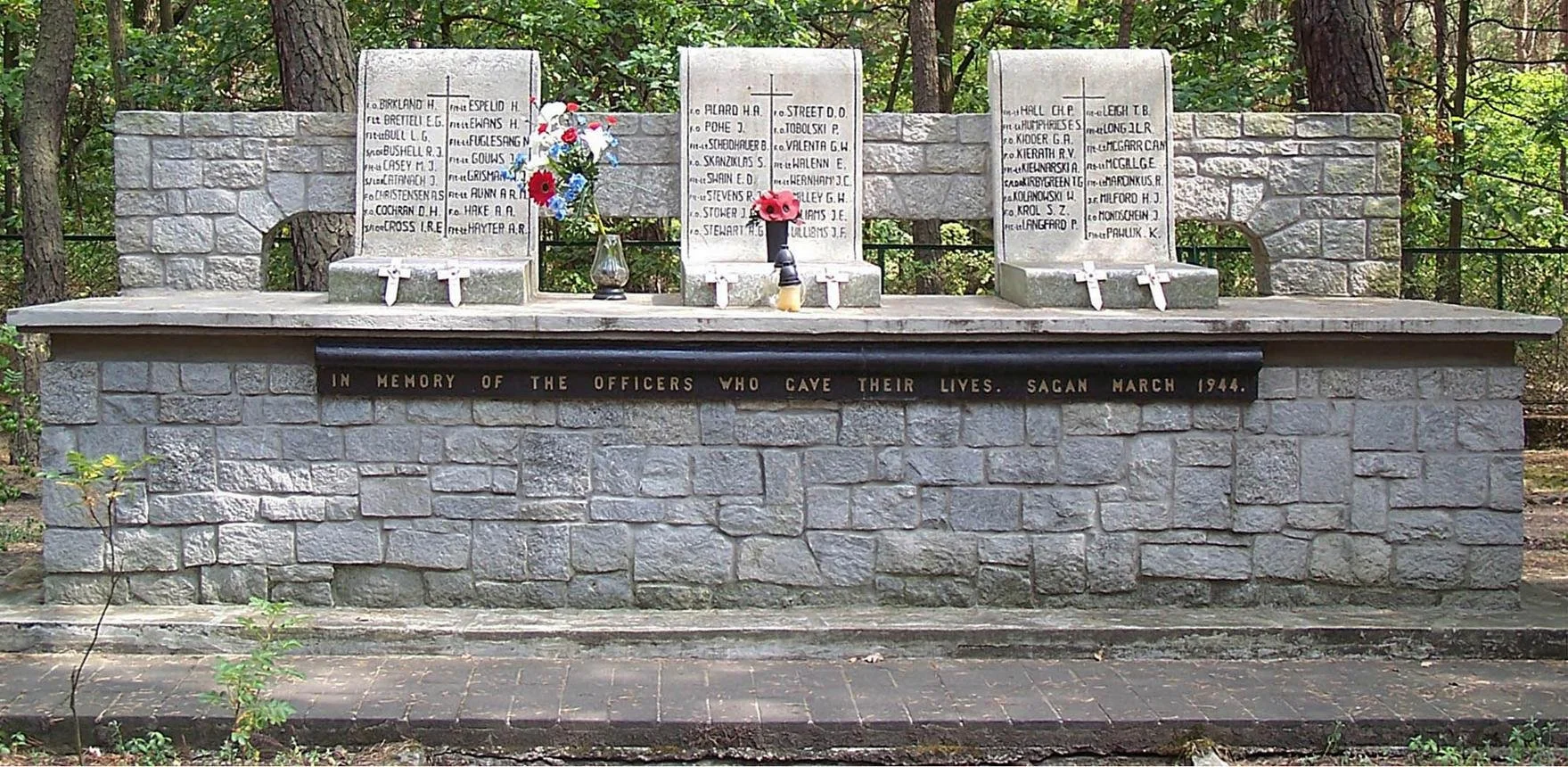
The Memorial to the Fifty at Stalag Luft III, built by fellow prisoners in memory of the airmen murdered after their recapture.
(Photo: CSvBibra / Wikimedia Commons, Public Domain)
From the camp perimeter, you follow the route into Żagań railway station. The station building still stands, and walking onto the platforms gives you the immediate physical context of the escape: the distance the men had to cover on foot in the snow, the civilian crowds they had to blend into, and how vulnerable an escaper in a home-made civilian suit really was the moment he reached the ticket counter.
Colditz — the castle, then the Tiergarten
Colditz, whose castle dates back to the 11th century, was designated Oflag IV-C, a high-security camp reserved for Allied officers who had repeatedly broken out of other camps or were considered especially dangerous to the German war effort. The Germans assumed the heavy stone walls and the sheer rock face above the River Mulde made the place impossible to leave. The prisoners treated that assumption as an operational challenge.
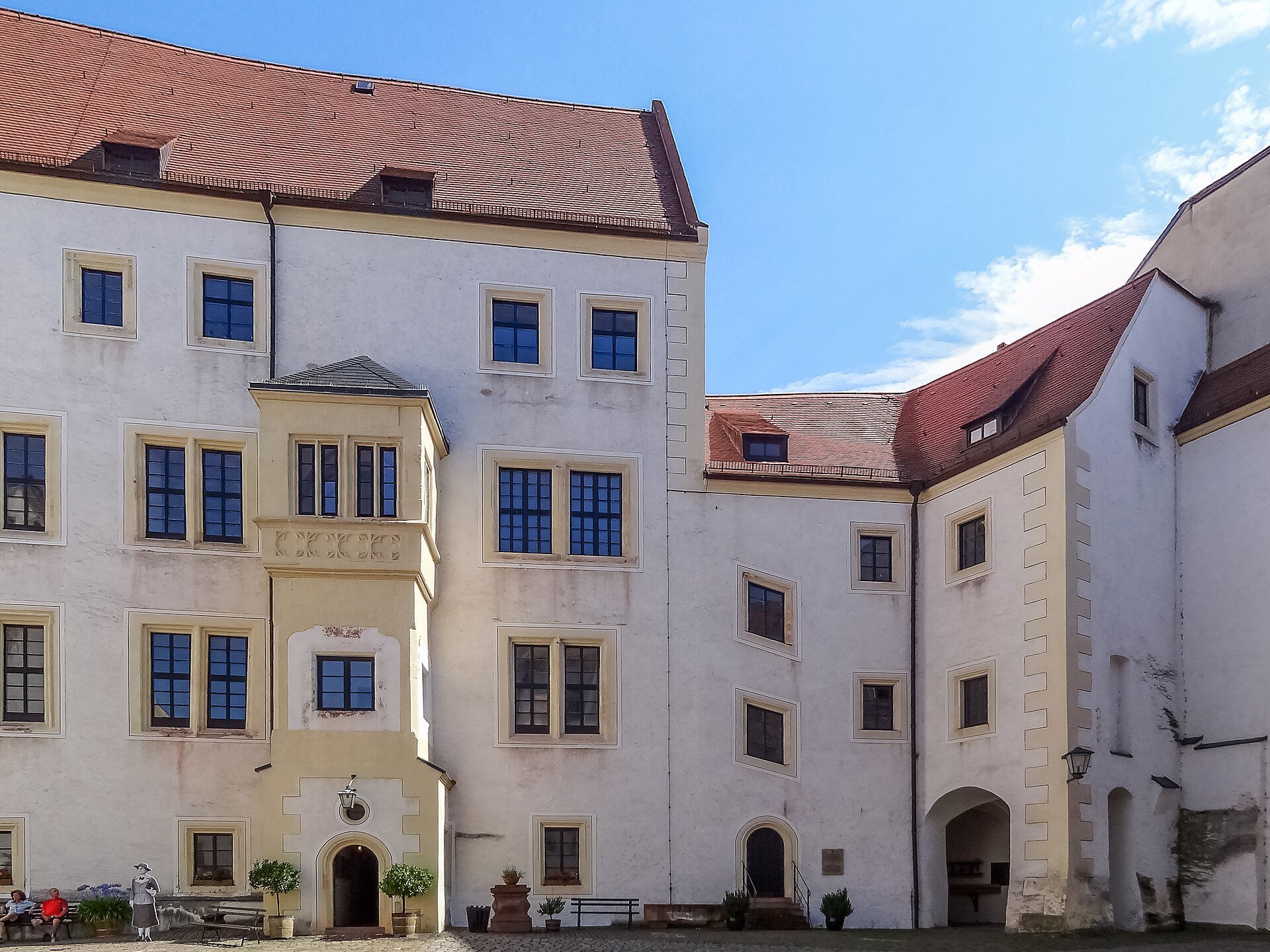
The inner courtyard of Colditz Castle, where Allied officers held at Oflag IV-C assembled for roll calls during the Second World War. (Photo: SatMi9 / Wikimedia Commons, CC BY-SA 4.0)
A specialist Colditz tour works best by moving from the inside out. We start inside the castle so you register the claustrophobia of the place. You walk the tight inner courtyard where roll-calls were held under armed guard, the winding stairwells, and the crowded quarters where British, French, Dutch and Polish officers lived side by side. You see the chapel, under which the French prisoners spent eight months digging a tunnel through the foundations of the castle, and the German officers' quarters.
Being inside the structure explains why the escape attempts were so varied and audacious. Somewhere between thirty and thirty-six men made it home from Colditz, depending on whose count you trust; more than a hundred got out of the castle and were caught on the road. In January 1942, British Lieutenant Airey Neave and Dutch Lieutenant Tony Luteyn, in home-made German uniforms, slipped under the theatre floor into the German side of the castle, walked out through the guardhouse, crossed the moat and went over the outer wall. In October 1942, Pat Reid and three others went out through the kitchen and the potato cellar, across the German courtyard and away. All four reached Switzerland.
The most ambitious escape plan never got the chance to be tested. In an attic above the chapel, British prisoners secretly constructed a two-man glider — later nicknamed the Colditz Cock — which they intended to launch from the castle roof across the valley below. The camp was liberated before the attempt could be made.
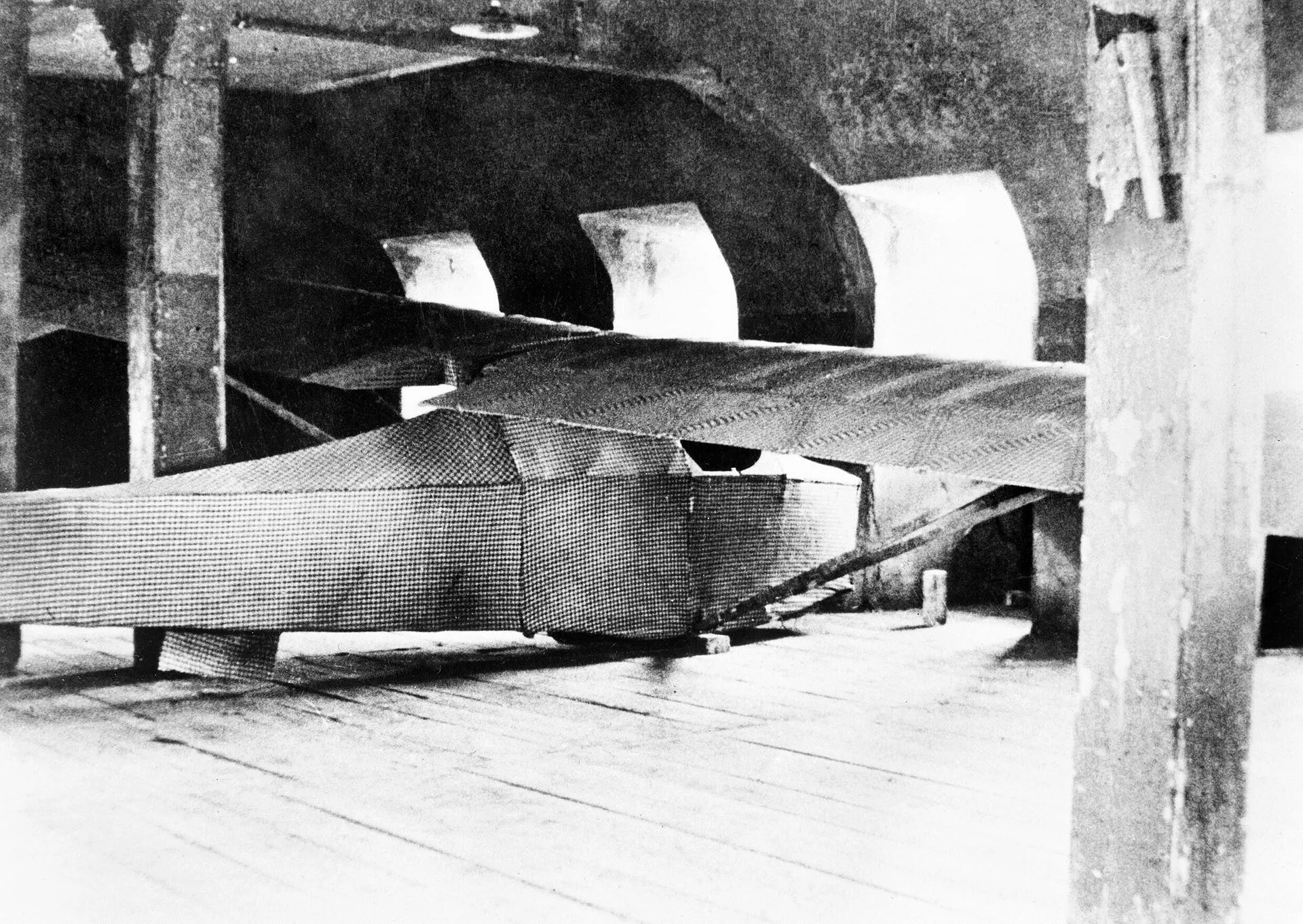
The original Colditz Cock glider, assembled in the attic above the chapel after the liberation of Colditz in April 1945. British prisoners had secretly constructed it in sections for an audacious escape attempt that was never carried out. (Lee Carson / Imperial War Museums, HU 49529 / Public Domain)
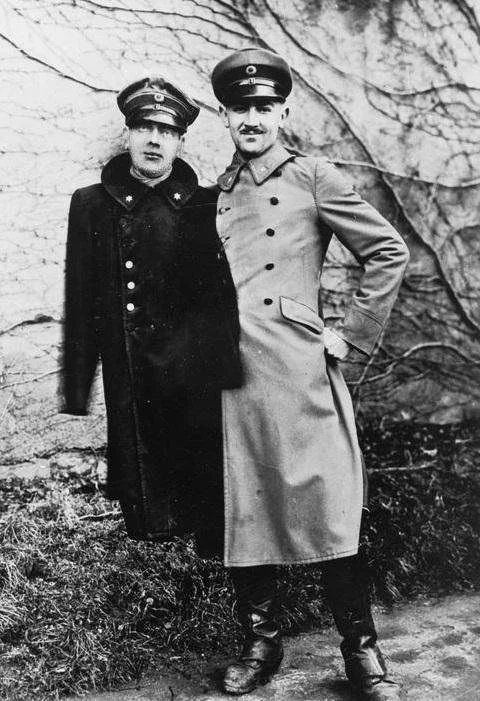
Dutch officers Diederik van Lynden and Evert Steenhouwer after being caught in German uniforms made for an escape attempt from Colditz.
There is a side of Colditz the films leave out. French officers refused to be billeted with their Jewish comrades, so the Germans put the Jewish-French officers in an attic the prisoners called the ghetto. Birendranath Mazumdar, an Indian army doctor, was told by the British that he could not escape because of the colour of his skin. Men broke down inside the castle, and some killed themselves after the war. This is the part I'd rather you heard standing in the courtyard than read on a screen, because the escape story only makes sense next to it.
After the castle interiors, we walk down into the Tiergarten. This was the walled park below the rock where prisoners were taken under armed escort for exercise. It was the scene of both the earliest and the latest dramatic chapters of Oflag IV-C.
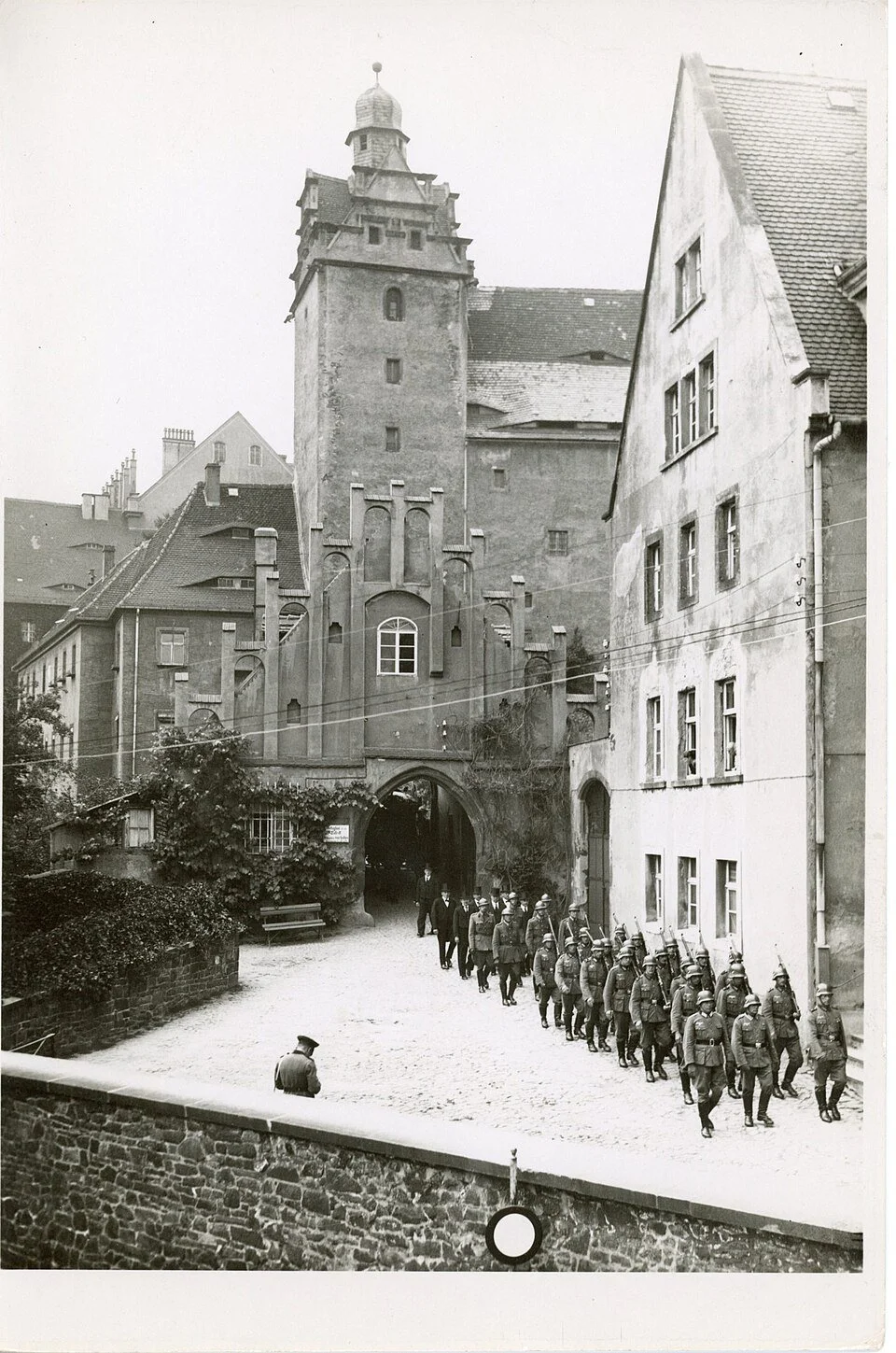
Prisoners from Oflag IV-C being escorted under guard outside Colditz Castle.
In April 1941, French Lieutenant Alain Le Ray made the very first successful escape from Colditz. On the exercise walk he slipped into the doorway of a terraced house on the edge of the park and stood still while the column passed. When the guards had counted the others back through the gate, he was over the wall and into the trees. He reached Switzerland.
Three and a half years later, in September 1944, British Lieutenant Mike Sinclair — known to both guards and fellow prisoners as the Red Fox for his relentless escape attempts — made his final dash at the Tiergarten wire. A German sentry fired, the bullet ricocheted off his elbow into his chest, and Sinclair was killed instantly. The Germans buried him in the town cemetery with a Union Jack the guards had sewn themselves; he was awarded a posthumous DSO, the only one given for escaping.
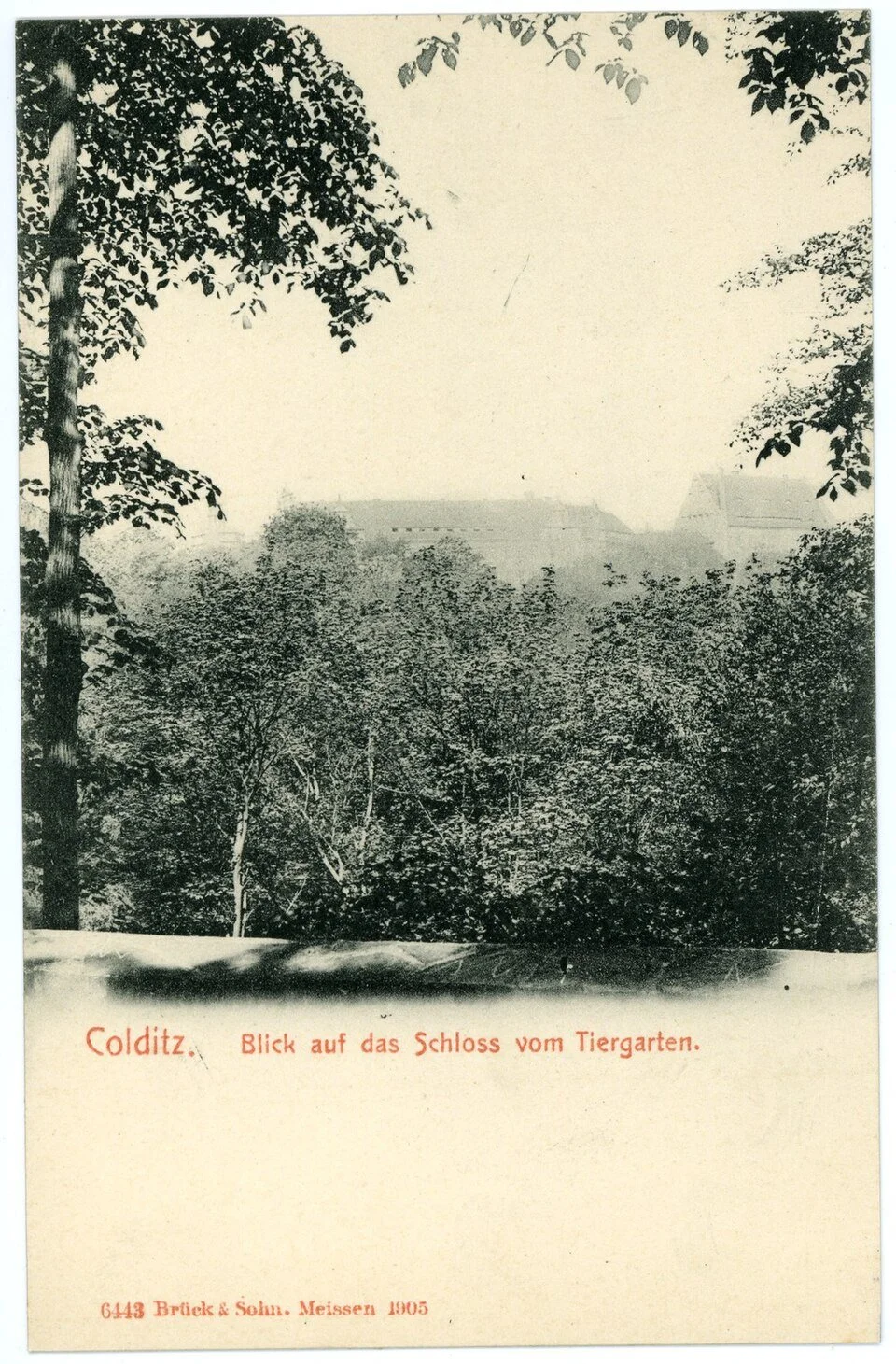
Colditz Castle seen from the Tiergarten in 1905. During the war, prisoners from Oflag IV-C were brought into the park below the castle for exercise.
We finish the visit down in the Tiergarten, with the forest air and the open ground around you. Then we walk back up the slope towards the castle. That walk back up the hill is the specific moment I want you to feel: looking up at those high stone walls and realising that this was a place a prisoner would risk a bullet to avoid returning to.
The war's last week — why Bautzen or Dresden on the way
Connecting Stalag Luft III in Poland to Colditz in Saxony means crossing Lower Silesia and the Upper Lusatian countryside. That driving day gives us a deliberate choice for the midpoint overnight stop: Bautzen or Dresden.
Dresden is the easier evening. It offers better hotels, good restaurants and somewhere to sit with a drink afterwards, and its own war story. We cover the February 1945 Allied bombing raids, the destruction of the old centre, and the post-war reconstruction of the Altstadt along the Elbe. For groups who want a relaxed pace and an easy evening between camp visits, Dresden works well.
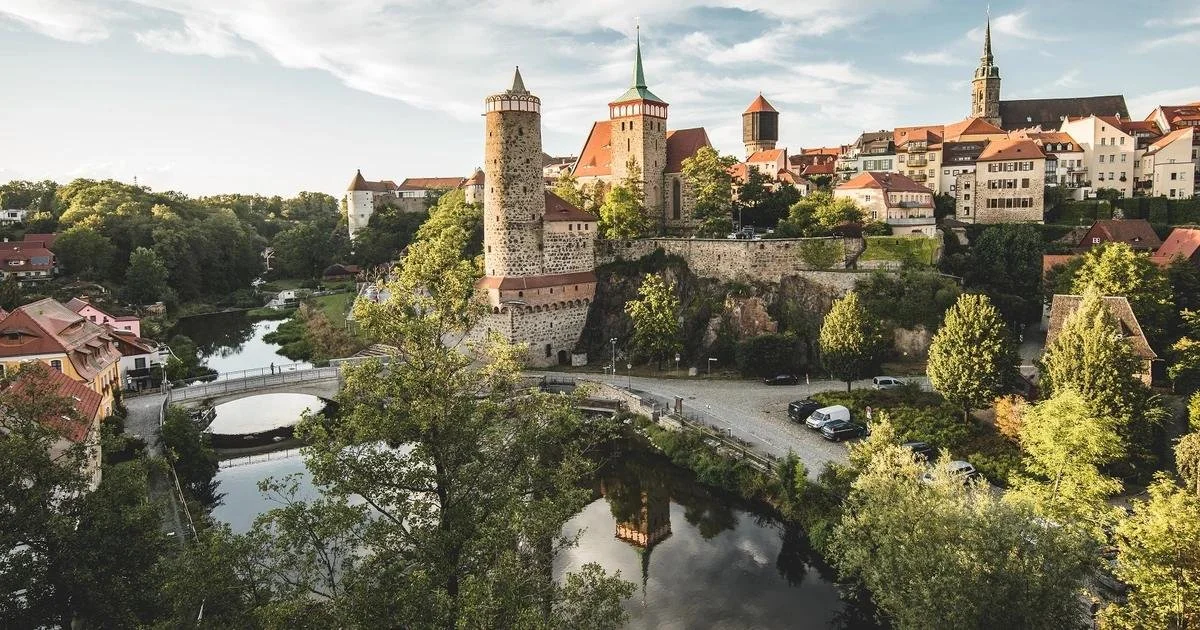
The Ortenburg above the River Spree in Bautzen. In April 1945, the medieval town became the scene of some of the last major fighting on Germany's Eastern Front.
Bautzen keeps you directly inside the combat narrative. In late April 1945, while the Red Army was closing the ring around Berlin, German armoured forces launched one of their last major counter-offensives of the war around Bautzen. Ferdinand Schörner's Army Group Centre sent the remnants of the 4th Panzer Army — 20th Panzer, Brandenburg and Hermann Göring divisions — into the flank of the 2nd Polish Army and its Soviet neighbours as they pushed towards Dresden.
The Battle of Bautzen turned into vicious, street-by-street fighting through the medieval town. It was one of the very few German tactical counter-attacks in 1945 that actually succeeded, retaking the town and inflicting heavy casualties on Polish and Soviet units. The Poles lost over 18,000 men dead, wounded and missing, roughly a fifth of their army, in six days. Staying in Bautzen shows you how hard the fighting continued right up to the final hours of the Third Reich, and how little the frontline reality matched the orderly maps drawn up in staff headquarters.
What a Great Escape tour like this costs
For a group of four, guiding and driving, the vehicle, fuel and all entrances come to roughly €3,500–4,000 for the group, so around €900–1,000 per person. Add three nights' hotels (typically €100–150 per person per night) and flights to your starting city, and most groups land between €1,400 and €1,800 per person all-in. Larger groups of up to seven bring the per-person guiding cost down.
How we build it
When people think of the Second World War sites in Europe they need to see, the list is predictable: Normandy, Operation Market Garden, and the Battle of the Bulge. Those are standard battlefield routes. Behind those Western Front campaigns sit Stalag Luft III and Colditz Castle.
Almost everyone knows the stories, but very few people ever get out to the ground. Colditz is a small town in rural Saxony, well away from regular tourist corridors. Żagań is an out-of-the-way town across the Polish border.
Building a functional route across this region requires dealing with practical logistics that do not show up in history books. You have cross-border vehicle regulations, one-way rental fees if you drop a vehicle in a different country, and the reality of regional road networks. When I laid out this itinerary, my priority was not to wreck the Colditz day with a long drive; you need to arrive at the castle fresh, on foot, with plenty of daylight to cover the ground properly.
These sites have changed significantly since 1945. The Colditz railway station where Allied prisoners were unloaded under guard sat derelict for decades. Stalag Luft III is now an open pine forest where you have to look closely to identify the drainage ditches, the foundation lines, and the physical limits of the compounds.
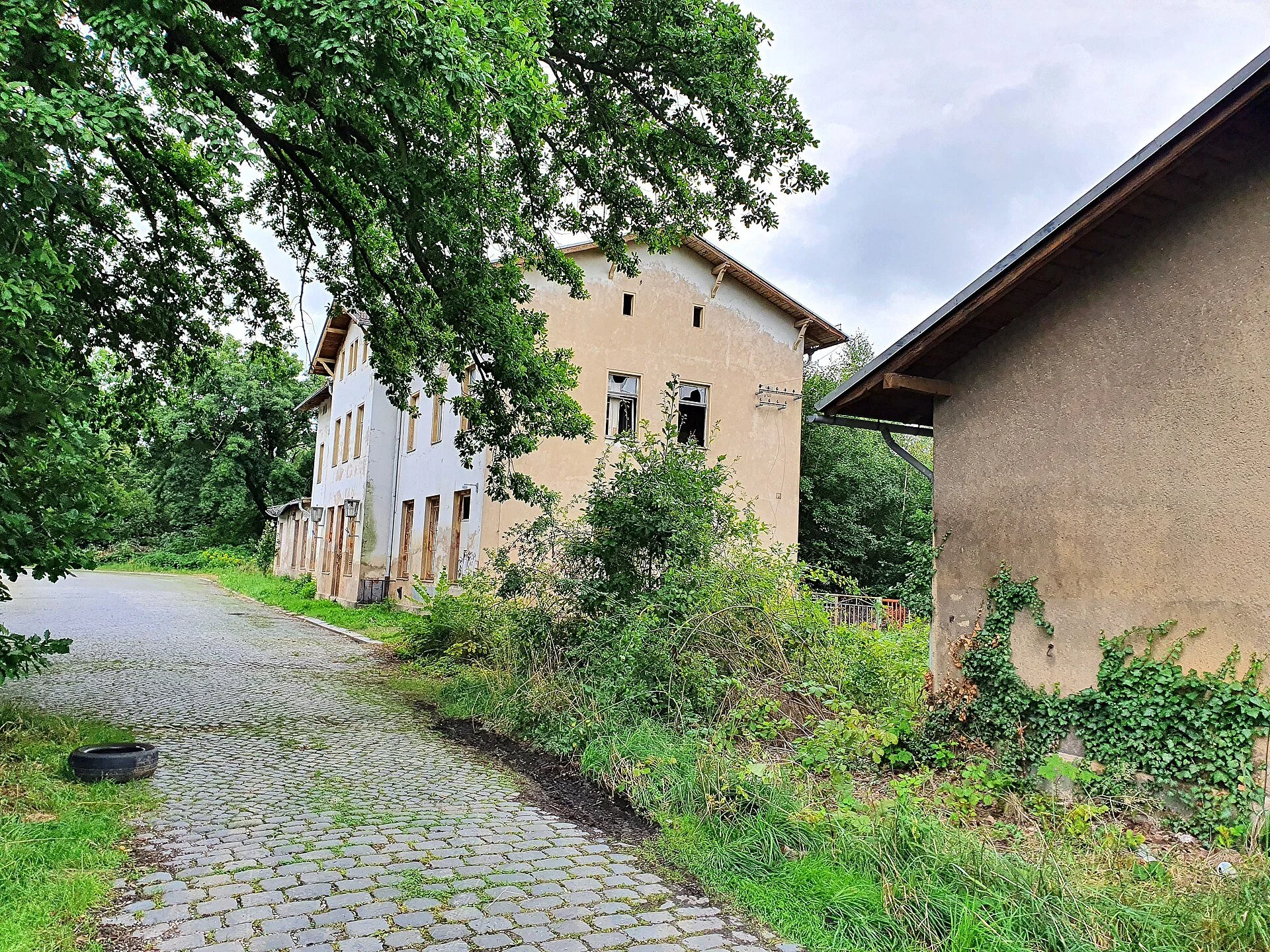
The former Colditz railway station. Allied prisoners arriving at Oflag IV-C were brought through the town from the station to the castle above.
A specialist guide's primary task on this terrain is to overlay the wartime map onto the modern landscape. Without someone pointing out the field of fire from a guard tower or the line Tunnel Harry ran, and why it came up short of the trees, you are simply looking at trees and stone. My infantry background and years of running military history tours in Germany mean I look at this ground through the lens of terrain, security sectors, and practical movement.
This tour is built for people who grew up on the classic escape accounts and want to see how the ground matches the record. If you are someone who enjoys spending weeks sorting out train timetables, hiring regional cars, booking small-town guesthouses, and working through local guidebooks on your own, you will have a solid trip doing it yourself.
This guided route is designed for the traveller who has already read the books, understands the broad history, and wants the nuance: the physical details on the ground that a guidebook does not cover, the logistics taken care of, and the back-and-forth discussion of military decisions with a guide who understands the realities of ground operations.
Five questions people ask
Is The Great Escape a true story, and is Stalag Luft III the actual camp?
Yes, the camp outside Żagań in Poland is the historical site where the March 1944 mass breakout took place. The film was shot in Bavaria for production convenience, but the layout depicted on screen was based directly on the North Compound of Stalag Luft III where the Allied airmen constructed Tom, Dick and Harry.
Can you visit Stalag Luft III and Colditz today, and what survives?
Yes, both are open to visitors: Colditz Castle stands almost entirely intact above the town, while Stalag Luft III consists of marked foundations, the traced tunnel line and a museum in the forest. At Colditz, you walk the original courtyards, cellars, chapel and escape routes; at Żagań, you see the concrete footings of the barracks, the reconstructed Hut 104, and the full run of Tunnel Harry marked out to the tree line.
Why are Stalag Luft III and Colditz combined into a single tour?
They represent the two interconnected halves of the Allied prisoner-of-war escape story in the European theatre. Airmen who broke out of standard Luftwaffe camps like Stalag Luft III and were recaptured were sometimes sent on to Colditz Castle — Lorne Welch, an RAF instructor, was a prisoner in both. That progression from the Silesian forest to the Saxon fortress is the natural way to understand how German security escalated.
Can we adjust the pace or add extra historical stops along the route?
Yes, because every tour is run as a private group, the daily schedule and overnight stops can be adapted to your preferences. Groups frequently choose between an overnight stay in Bautzen to study the 1945 tank battle or Dresden for the air war history, and additional days can be added for the Elbe link-up at Torgau or Berlin.
Who is this tour best suited for?
This itinerary is designed for people who have read the books and want to see the ground with a guide rather than manage cross-border logistics independently. It suits individuals, families, or small groups of friends who want good conversation, the detail on the ground, and a private vehicle between regional sites in Poland and eastern Germany.
Enquire about this tour
Tell us your ideal travel dates, your group size, and whether you prefer Bautzen or Dresden for your midway stop. We will build a custom private itinerary and get back to you with the details.
Image credits
Historical and contemporary images used throughout this article are reproduced from Wikimedia Commons and archival collections. Public-domain images are identified where applicable; Creative Commons images are reproduced under their respective licences.
Colditz Castle, April 1945: U.S. military or Department of Defense employee / Wikimedia Commons. Public Domain (U.S. Government work). Wikimedia Commons

Robert Stanford Tuck and Roger Bushell at Stalag Luft III: Official photographer / Imperial War Museums, HU 1605. Public Domain (expired UK Crown Copyright). Wikimedia Commons

Route of Tunnel Harry at Stalag Luft III: CSvBibra / Wikimedia Commons. HarrySagan1.jpg and HarrySagan2.jpg. Both photographs released into the Public Domain by the photographer. Composite created from the two photographs. Wikimedia Commons

End of Tunnel Harry, Stalag Luft III: Vorwerk / Wikimedia Commons. CC BY-SA 3.0. Wikimedia Commons

Memorial to the Fifty, Stalag Luft III: CSvBibra / Wikimedia Commons. Released into the Public Domain by the photographer. Wikimedia Commons

Inner courtyard of Colditz Castle: Original photograph by SatMi9; derivative work by Georgfotoart / Wikimedia Commons. CC BY-SA 4.0. Wikimedia Commons

Original Colditz Cock glider, April 1945: Lee Carson / Imperial War Museums, HU 49529. Public Domain (expired UK Crown Copyright). Wikimedia Commons

Lieutenant Leo de Hartog with “Moritz”, Colditz, 1941: German official photographer / Imperial War Museums, HU 4225. Public Domain (expired UK Crown Copyright). Wikimedia Commons

Prisoners from Oflag IV-C, Colditz, 1941: Unknown photographer / Wikimedia Commons. Public Domain (anonymous work, copyright expired).
Colditz Castle from the Tiergarten, 1905: Brück & Sohn Kunstverlag Meißen, postcard no. 06443 / Wikimedia Commons. CC0 1.0 Universal Public Domain Dedication.
Ortenburg, Bautzen: Frank Vincentz / Wikimedia Commons. CC BY-SA 3.0. Wikimedia Commons

Former Colditz railway station: Cookroach / Wikimedia Commons. CC BY-SA 4.0.