
Nazi Wonder Weapons the V-1 and V-2 Rockets
Hello and welcome to the On the Front blog, where we discuss all things WW2
In today’s blog we are going to discuss the Peenemünde Army Research centre. This facility produced the world’s most technologically advanced weapon systems, touted as wonder weapons by Adolf Hitler. What were these weapons? The V1 and V2 rockets.
Development of the Penemünde site began in 1936 and was completed in one year using the forced labour of concentration camp prisoners. The site would continuously be developed resulting in the facility eventually having its own dedicated concentration camp. The site itself consisted of an airport, a Seaport, a series of productions facilities, hundreds of apartment building for the thousands of scientists, multiple missile launch pads, a powerplant and wind tunnel capable of reaching speeds of Mach 4.4.The site grew so large in fact that it needed its own railway network which became the third largest rail network in Germany behind Berlin and Hamburg.
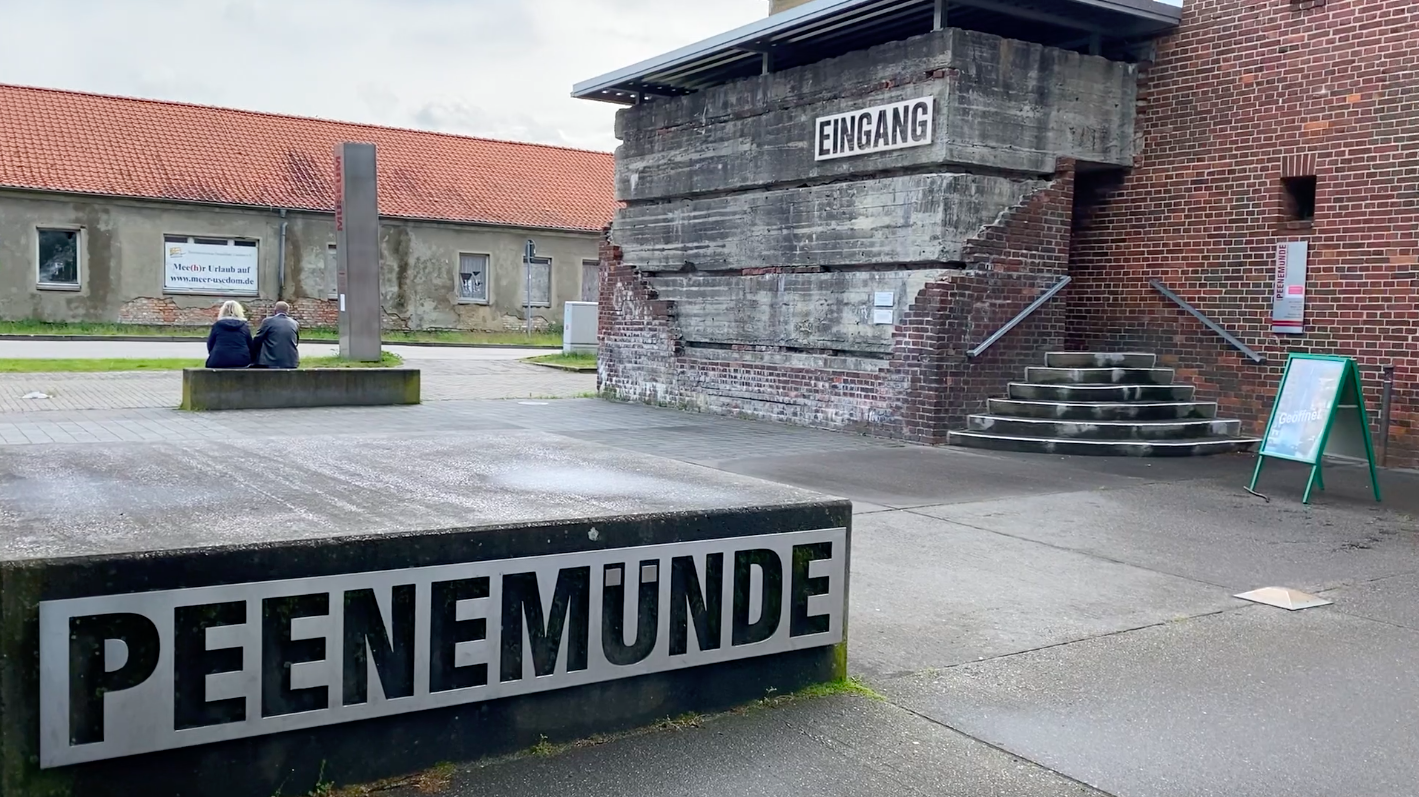
Peenemunde site entrance

Powerplant and location of present museum
The power plant is the only section of the facility that survives in its original condition. The plant was used by the Soviets up until 1990 to power the East German power grid. Everything else was destroyed by the Soviets as part of their agreement with the Allies. There are a number of bunkers scattered around if you have the time to wonder the grounds of this huge site.
V-1 Flying Bomb

V1 Flying bomb
Development of the V1 began in 1939 and was the first incarnation of the vengeance weapons that were developed by the Nazi’s. Code named Kirschhern (Cherry Stone) the V-1’s would later be nicknamed Doodlebugs by Londoners because of the iconic sound they would make.
Testing for the V-1 began in early 1941 but they would not be put into action until June 13th, 1944 one week after the successful allied landings at Normandy. Their target was London, the first V-1 hit Grove Road, Mile End in South London. At its peak 100 V-1’s were fired at London every day in events which became known as the second Blitz.

V1 Flying Bomb display at Peenemunde facility
The V-1 carried an 850kg warhead and was propelled off of a launch track. Guided by a simple compass heading the V-1 was equipped with a front censor which calculated how far it had flown and after the distance was up the engines would cut off and it would nosedive into the ground. The result of this simple to calculate trajectory made the rockets easy to shoot down. RAF fighter squadrons tasks with destroying the V-1’s before they came over London would on occasion to save ammunition use their wing tips to knock the V-1 off course which would cause the missiles too loose control and crash early in empty fields or over the Channel.
The limited range of the V-1 meant they were fired from launch sites on the French and Dutch coast lines. The V-1 attacks over England ceased in October 1944 as the allies made their way further inland and overran the launch sites within range of the English Isles. After this the V-1’s were targeted elsewhere with the last V-1 attack occurring on March 29, 1945.
V-2 A4 Rocket

V2 Rocket on display at Peenemunde facility
The granddaddy to all modern cruise missiles the V-2 weapon system would lay the groundwork to putting the first man on the moon. Development of the V-2 began in 1941 and was the upgrade to the V-1. During its development Hitler was not impressed by the rocket describing it as an artillery shell with a longer range and greater cost.
Able to carry a 1 tonne war head, the V-2 was enormously sophisticated. Controlled by an onboard gyroscope to regulate trajectory the V-2 would leave the Earth’s atmosphere (the first rocket ever able to do so) and then free fall at supersonic speed onto its target making it impossible to defend against. Modern air Défense systems would still find it difficult to shoot a V-2 down once it made its decent.
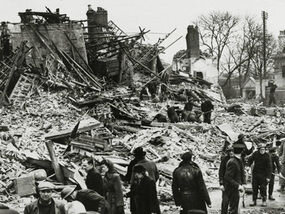
Londoner’s in the aftermath of a rocket attack
As the war dragged on Hitler needed a morale booster for the German people and approved the development of the V2 touting it as a Wonder Weapon to win the war. In total 3,000 V-2’s were constructed and fired at targets in London, Antwerp and Liege. The bombings would result in 12,000 civilian deaths.
The construction of these weapons fell to concentration camp prisoners. The terrible working conditions at the manufacturing facilities related to production of the V-2 resulted in the deaths of over 20,000 inmates. It is the only weapon ever built to result in more deaths during construction then in action.

RAF reconnaissance photo of Test Stand VII
Penemünde was the development site of the V-Series rockets until 1943 when it became the target of British and US bombers during Operation Crossbow. Two Polish janitors at the facility managed to sneak out maps detailing the area. As part of operation Hydra, in August 1943, the first bombers made their pass, initially targeting the research facilities living and housing quarters to kill the scientists at the facility.

Wernher Von Braun surrounded by Wehrmacht officers
Nazi high command became concerned over the venerability of the site and moved the development and manufacturing of the weapons to Mittlewerk an underground manufacturing site in Kohnstein central Germany. Penemünde remained in operation but only as a testing site. The facility was captured by Soviet soldiers of the 2nd Belorussian Front on May 5th, 1945. The facility had long been abandoned and strategic installations destroyed.
Development of the V-Series weapons was the responsibility of Wernher Von Braun a young mechanical engineer who became fascinated by the writing of Hermann Oberth a pioneer in the development of rocket technology and space travel theorist.

Wernher Von Braun with US President Kennedy
After the war Von Braun surrendered to the Americans. He and 1,600 other German scientists were secretly moved to the United States as part of Operation Paperclip. A secret program used to boost the US in the Space race against the Soviet Union.
The Soviets too recruited German scientists but in a more aggressive way forcibly moving 6,000 German scientists including their families at gun point to Russian rocket facilities.
Von Braun along with other German scientist would be eventually be recruited to NASA in the 1960’s. Von Braun worked on the Apollo Program was the chief architect behind the Saturn V Super Heavy Launch Vehicle the propelled the Apollo spacecraft to the moon.
The V-Series weapons were touted as Wonder Weapons by Hitler that would win the war for Germany but in truth these expensive weapons had very little impact. In fact, researchers now believe these and other “Wonder Weapons” may have even expedited Germany’s surrender as their development and production starved the German Wehrmacht of valuable and vital recourses.
Let me know your thoughts about Hitler’s V1 and V2 wonder weapons in the comments below. Thank you for reading and I’ll see you next time On the Front.

Abandoned Nazi Mega Structure. Hitlers holiday resort
Hello and welcome to the On the Front blog, where we discuss all things WW2.
In this blog, I am going to discuss the Colosuss Prora resort. This Nazi era building complex is located on the island of Rügen, in northern Germany. Built between 1936 and 1939 the complex was designed as a holiday beach resort through the Kraft durch Freude KdF (Strength Through Joy) project. Designed for 20,000 guests, this 4.5km long Nazi mega structure is the longest building complex in the world. Consisting of eight identical buildings 150m from the beach. The surviving structures stretch a whopping 3km.
The Strength Through Joy project was a state initiative founded in November 1933 to provide working class Germans with affordable holiday opportunities which initially were only available to the middle and upper classes. The project was operated in conjunction with the state propaganda ministry and allowed Germany’s poorest access to Theatre tickets, hiking and day trips. By 1937 some 9.6 million Germans had taken part in a Strength Through Joy excursion.

Holiday makers apart of the KdF program
In cooperation with the Italian dictatorship Strength Through Joy also offered international travel to the Italian Riviera and skiing holidays in the Italian Alps. The project was a huge success selling some 45 million tours by the outbreak of WWII.
The construction of Prora was an ambitious project. Hitler insisted that all rooms were to have a sea view. Plans were made for a gigantic celebration hall supposedly able to house all 20,000 guests at the same time. There were two wave pools, a theatre and a cinema. Costing an astounding 237.5 million Reichsmarks (57 Million Euros today), the project was never realised, construction grinned to a halt at the outbreak of WWII.

Abandoned section of Prora resort
During the war the empty complex was used as a place to shelter during air raids, emergency housing for refugees and accommodation for female auxiliary personnel for the Luftwaffe.
In 1945, the Soviet Army took control of the site and turned it into a military base, stripping the buildings of any value. The soviets demolished large sections of the Northern and southern building complexes. In the 1950’s, control of the site was given to the East German Government (Deutsche Demokratische Republik. DDR) and with the creation of the National Peoples Army (National Volks Army. NVA) in 1956 the building was turned into a military barracks. The surviving interior décor which can be seen still in its un-renovated state today.

Last remaining original sections under going renovation
Following German reunification in 1990 the NVA was folded into the West German Bundeswehr and the site would continue to serve as a military barracks for a short time. From 1992 -“94, the complex was transformed to a refugee centre and housed asylum seekers from the Balkans.
For the remainder of the 90’s the complex was largely abandoned except for use as a museum, exhibition centre and art gallery. Unsuccessful attempts to sell the site resulted in a Government backed initiative to convert part of the complex into a youth hostel, making it the largest youth hostel in Europe.
In 2004, it was decided to sell the site in sections with multiple investors buying up large sections and plans were approved in 2008 to turn the site into its original intended purpose of a holiday resort.

Renovated sections of Prora resort
Criticism from locals who felt there were already too many tourists in the region or that the sites history made in inappropriate for tourism development were overruled and the revamped Youth Hostel with over 400 beds (Germany largest youth hotel) opened in 2011. Further development by multiple investors has breathed new life into the complex with the site now housing a luxury hotel, shopping centre and art gallery. Several blocks have also been converted into luxury apartments marketed as holiday homes. These beach apartments can also be found for long and short rental on multiple online booking platforms.
Let me know your thoughts about Prora resort and if you would book a stay in any of the accommodation in the comments below. Thank you for reading and I’ll see you next time On the Front.