

What Was The Third Reich?: Berlin's Dark Transformation 1926-1933
Berlin's transformation from 1926-1933: Nazi rise to power through propaganda, violence, and economic crisis. A city's fall into tyranny and the birth of the Third Reich.
Berlin's streets hide secrets of a wild past where democracy fell and tyranny rose. From 1926 to 1933, the Nazi Party took power and transformed not just the German capital but the whole of the German Reich and the world. Follow us as we explore the key events, people and places that shaped this period and the steps that led to one of humanity's darkest hours.
Berlin in the late 1920s was a city of contradictions and growing unease. The city was a hotbed of culture and liberal thinking and simultaneously economic hardship and political chaos after the First World War. The Weimar Republic, Germany's fragile democracy, struggled to keep the lid on rising extremism from the left and right. Into this volatile mix, the Nazi Party, led by Adolf Hitler, was looking to spread its influence beyond its Bavarian heartland. Berlin, a city that was largely hostile to Nazi ideology, was the prize, and the task fell to a man who would become the master of propaganda and manipulation: Joseph Goebbels.
Key Terms and Definitions
Before we get into the transformation of Berlin, it's good to understand some key terms and concepts:
Third Reich: Literally "Third Empire" or "Third Realm", this refers to Nazi Germany from 1933 to 1945, seen as a successor to the Holy Roman Empire and the German Empire of 1871-1918. The Nazis used this term to mean a new powerful German state.
Nazi Party: Short for National Socialist German Workers' Party (Nationalsozialistische Deutsche Arbeiterpartei or NSDAP), a far-right political party led by Adolf Hitler. Founded in 1920, it rose to power in the 1930s and became the ruling party of Germany.
Nazi Government: The political regime led by Adolf Hitler and the Nazi Party from 1933 to 1945 was characterised by totalitarian control, aggressive expansionism and the implementation of Nazi ideology.
Weimar Republic: The unofficial name for Germany from 1919 to 1933, a democratic regime established after World War I and before Nazi rule. Named after the city where the constitution was drafted, the Weimar Republic faced many challenges, including economic instability and political extremism.
Propaganda: Information, especially of a biased or misleading nature, used to promote a political cause or point of view. A vital tool in the Nazi rise to power. The Nazis used various forms of propaganda, including radio broadcasts, films, posters and mass rallies to spread their ideology and maintain control.
Antisemitism: Prejudice, hostility or discrimination against Jews. A core tenet of Nazi ideology that would lead to the Holocaust. Antisemitism had deep roots in European history, but the Nazis took it to unprecedented extremes implementing policies of persecution and, ultimately, genocide.
Totalitarianism: A system of government that is centralised and dictatorial, requiring complete subservience to the state. Under Nazi rule, Germany became a totalitarian state, with the government controlling nearly every aspect of citizens' lives.
Gleichschaltung: A Nazi policy of forced coordination and synchronisation of all aspects of society, including politics, culture and the economy to align with Nazi ideology.
Lebensraum: Literally "living space", the Nazis used this concept to justify territorial expansion, particularly in Eastern Europe, to provide land and resources for the German people.
Führer: German for "leader" or "guide" This title was adopted by Adolf Hitler as the supreme leader of Nazi Germany, combining the roles of Chancellor and President.
Gestapo: Short for Geheime Staatspolizei (Secret State Police), this was the official secret police of Nazi Germany known for its brutal methods and role in suppressing opposition to the regime.
These will give you context for what happened in Berlin during this period. They are the ideological framework, political structure and societal changes of Nazi Germany and its capital. As we look at Berlin's transformation, these will help us understand the impact of the Nazi regime on the city and its people.
Joseph Goebbels: The Man Who Would Shape Nazi Berlin
On a cold November day in 1926, 29-year-old Joseph Goebbels stepped off a train at Anhalter Bahnhof with a task that seemed impossible: to win Berlin for the Nazis. The city, as Mark Twain called it, "the Chicago of Europe", was a city of many political ideologies, from communists to social democrats to monarchists.

Joseph Goebbels

NSDAP regional office in Berlin, Potsdamer Straße.
Goebbels' first stop was Potsdamer Straße 109, the Nazi Party headquarters. The basement office, nicknamed the "opium den", was smoky and stank of stale beer – not exactly the most promising start for a movement with big plans. But it was from here that Goebbels would launch a campaign of propaganda and violence that would bring Berlin under Nazi control.
Goebbels' Plan: Propaganda and Intimidation
To turn the Nazi's fortunes into "the reddest city in Europe after Moscow", Goebbels used a two-pronged approach that would become a Nazi staple:
Propaganda
Street violence
Key points:
Reorganise party leadership to get rid of internal opposition
Make provocative public speeches that played on people's fears and resentments, based on the Nazi ideology called for the elimination of 'racially inferior' peoples and the establishment of Aryan supremacy.
Mobilise the SA (Sturmabteilung) to intimidate and attack political opponents.
Use modern technology like radio and film for mass communication.
Goebbels, a failed novelist with a PhD in literature, knew the power of words and images. He created a narrative of German victimhood and Nazi salvation that many disaffected citizens would buy into.
The Art of Speech
Goebbels was a great orator; he could get crowds excited with his speeches. He knew the power of repetition and simplicity. His speeches often focused on:
The "stab-in-the-back" myth is that internal enemies caused Germany's defeat in WWI.
The threat of "Jewish-Bolshevism" to German culture and society.
The promise of a strong Germany under Nazi leadership.
These were carefully staged affairs, with dramatic lighting, music, and crowd control to create a religious atmosphere. Goebbels knew politics was as much about emotion as it was about policy.
The Pharussäle Incident: Violence Breaks Out

Pharussäle beer hall Post Card
On February 11, 1927, Goebbels' strategy paid off. At the Pharussäle beer hall in Wedding, a working-class district of Berlin, a Nazi rally turned into a violent fight with communist protesters. The SA, led by the brutal Kurt Daluege, beat back the opposition with brass knuckles and rubber truncheons. Goebbels spun the event into a propaganda victory, with the Nazis as heroes against "red terror".
After Pharussäle
The Pharussäle incident was a turning point in the Nazi's Berlin strategy. It showed they were willing to use violence to get what they wanted and could control the narrative through propaganda. In the days after the fight, Goebbels' newspaper Der Angriff (The Attack) published sensationalised stories of communist brutality and Nazi heroism.

Der Angriff (The Attack) Newsletter
This also energised Nazi supporters who saw themselves as soldiers in a political war. The SA, in particular, grew in numbers and audacity after Pharussäle and more and more violent clashes with political opponents on Berlin's streets.
Economic Crisis: Perfect Storm for Extremism
The late 1920s were a time of economic collapse in Germany:
Hyperinflation destroyed the German economy, wiped out savings and undermined democratic institutions.
The 1929 Wall Street Crash triggered a global depression that hit Germany hard.
By 1932, unemployment in Berlin was 600,000, and breadlines and soup kitchens were familiar sights.
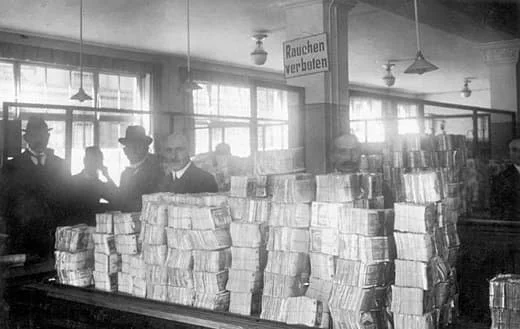
Piles of worthless inflated Reichsmarks
It was desperation time. Families were being evicted from their homes, and once proud workers were begging on street corners. This economic chaos was the perfect breeding ground for extremist movements promising simple solutions to complex problems.
The Human Toll of Economic Collapse
The economic crisis of the late 1920s and early 1930s had a daily impact on life in Berlin:
Families had to sell their belongings to buy basic necessities.
Children went to school hungry and couldn't concentrate.
Suicide rates soared, especially among the middle class, who had lost everything.
Crime rates increased as people turned to theft and prostitution to survive.
These conditions created a sense of hopelessness and anger, and the Nazis were quick to capitalise on it. They offered not just economic solutions but scapegoats for Germany's problems.
The Nazis' "Socialism of Action"
Goebbels took advantage of this and launched a "Socialism of Action" campaign. Party members opened their homes to the unemployed and offered hot soup and a sense of belonging. Nazi welfare organisations like the National Socialist People's Welfare (NSV) provided food, clothing and medical care to those in need – but only to "racially pure" Germans.
This worked even on die-hard communists who saw the Nazis as the only ones doing something to help. Of course, the ultimate goal was not charity but a dependent population loyal to the Nazi cause.
Walk in their footsteps: Our tours take you through the working-class neighbourhoods where the Nazis' empty promises of economic salvation found willing ears. See the buildings where soup kitchens operated and hear the stories of those who were seduced by Nazi propaganda.

“Our last Hope: Hitler” - propaganda poster
The Dark Side of Nazi Charity
While the Nazis' welfare programmes provided relief to many Germans, they also had a darker purpose. These programmes were used to:
Gather information on individuals and families for future use.
Brainwash recipients with Nazi ideology.
Exclusion and further marginalise groups deemed "unworthy" by the regime.
The NSV, in particular, was instrumental in implementing Nazi racial policies, deciding who was worthy of assistance based on racial and political criteria. This seemingly charitable organisation would later be complicit in some of the regime's worst atrocities.
The Beer Hall Putsch: A Turning Point in Nazi Tactics
The Nazi Party's rise to power in Berlin was influenced by the lessons of the Beer Hall Putsch in Munich in 1923. Hitler's failed attempt to seize power by force led to his arrest and the temporary ban of the Nazi Party. However, it also gave them valuable experience that would inform their future strategy and ultimately lead to their rise to power in Germany.

Hitler pitched with esteemed General Ludendorf during the Beer Hall Putch Trial
The failed putsch was a turning point for Hitler and his followers, forcing them to re-evaluate their strategy and long-term goals. Here are the lessons they drew from this experience:
The rule of law: After his release from prison, Hitler decided to get power through apparently legal means, manipulating the democratic system rather than overthrowing it. This change of approach allowed the Nazis to operate within the Weimar Republic while working to undermine it from within.
Martyrdom: The failed putsch allowed the Nazis to present themselves as persecuted patriots, those who died in the attempt as party martyrs. This narrative of sacrifice and dedication to the cause became a powerful tool for recruitment and propaganda, appealing to national pride and victimhood.
The breadth of support: The putsch's failure showed the need for a mass movement and support from key institutions like the military and big business. Hitler realised that to succeed, the party had to extend its appeal beyond its core base and build alliances with influential parts of German society.
Propaganda: The events surrounding the putsch demonstrated the power of media coverage and public perception. This led to an increased focus on propaganda and message control, with Joseph Goebbels later becoming the master of Nazi propaganda.
Timing: The failed coup taught Hitler and his followers the importance of waiting for the right moment to strike. They learned to be patient and opportunistic, capitalising on crises and public discontent to advance their agenda.

Soldier’s in the streets during the Beer Hall Putsch
In Berlin, Goebbels put these lessons into practice with brutal effectiveness. The party focused on propaganda, electoral politics and the gradual penetration of existing power structures. The SA's violent tactics were now balanced with a layer of respectability, allowing the Nazis to appeal to a broader base while still intimidating their opponents.
The Nazis' new approach in Berlin included:
Massive rallies and parades to show off their strength and popularity.
Using modern technology like radio and film to disseminate their message.
Targeting specific groups with tailored propaganda.
Infiltrating local government and civic organisations.
Building a network of informants and supporters across all levels of society.
See the transformation: Our tours show how the Nazis' approach in Berlin was different from their earlier, more overt attempts at revolution. Visit the places where the party held rallies and campaign events, where they showcased their new "legal" strategy for power. You'll see how the Nazis went from a marginal group to a major force in the capital.
As you walk through Berlin, you'll get to see how the lessons of the Beer Hall Putsch were put into practice in real-time, how the Nazi Party's tactics were shaped and how it led to their rise to power. This tour is a chilling warning about the dangers of extremism and the importance of defending democracy.
Hitler's Final Push for Power
As the 1932 elections loomed, the Nazi propaganda machine went into overdrive, using new tactics that would change the face of politics:
Hitler flew around Germany, a new campaign tactic that allowed him to speak in multiple cities in one day.
Huge rallies, like the 80,000-strong one in Berlin's Lustgarten, showed off the party's growing strength and popularity.
In his speeches, Hitler called for drastic measures to restore Germany to its former glory, further mobilising support for the Nazi cause.
Hitler proclaimed the necessity to utilise all means to inflict lasting damage on the striking power of the enemy.
The SA flooded the streets with swastika flags and mobile loudspeakers, making the party omnipresent.
Posters of Hitler's piercing gaze and promises of "Work and Bread" covered the city walls.
The Nazis also used modern technology, producing films like "Hitler Over Germany", where their leader was portrayed as a messianic figure descending from the skies to save the nation.
See where history was made: Visit the Lustgarten on our tour and hear the roar of the crowd as Hitler's words boomed across the square. Our guides will explain the psychological impact of these mass events on the German people.
Nazi Imagery
The Nazis knew the power of visual propaganda. Their use of symbols and imagery was designed to elicit strong emotions:

Hitler gives a speech at the third Nazi Party Congress in Nuremberg, August 1927.
The swastika, an ancient symbol hijacked by the Nazis, was everywhere in German cities.
The Nazi flag's bold red, white and black design was chosen for maximum visibility.
Uniformed SA and SS men created an image of power and order.
Posters and films showed Hitler as a messianic figure, often with religious imagery.
These elements combined to make the Nazis seem pervasive and unstoppable before they even had power.
Election Victory and the Road to Dictatorship
In the November 1932 election, the Nazis became the largest party in Germany, with 33.1% of the vote. They didn't quite have a majority but were strong enough to demand concessions from the weakened political elite.
Through backroom deals and political wrangling, orchestrated in part by former Chancellor Franz von Papen, Hitler was appointed Reich Chancellor on January 30, 1933. The Nazis had power through a legal loophole, a fact they would later use to justify their regime.
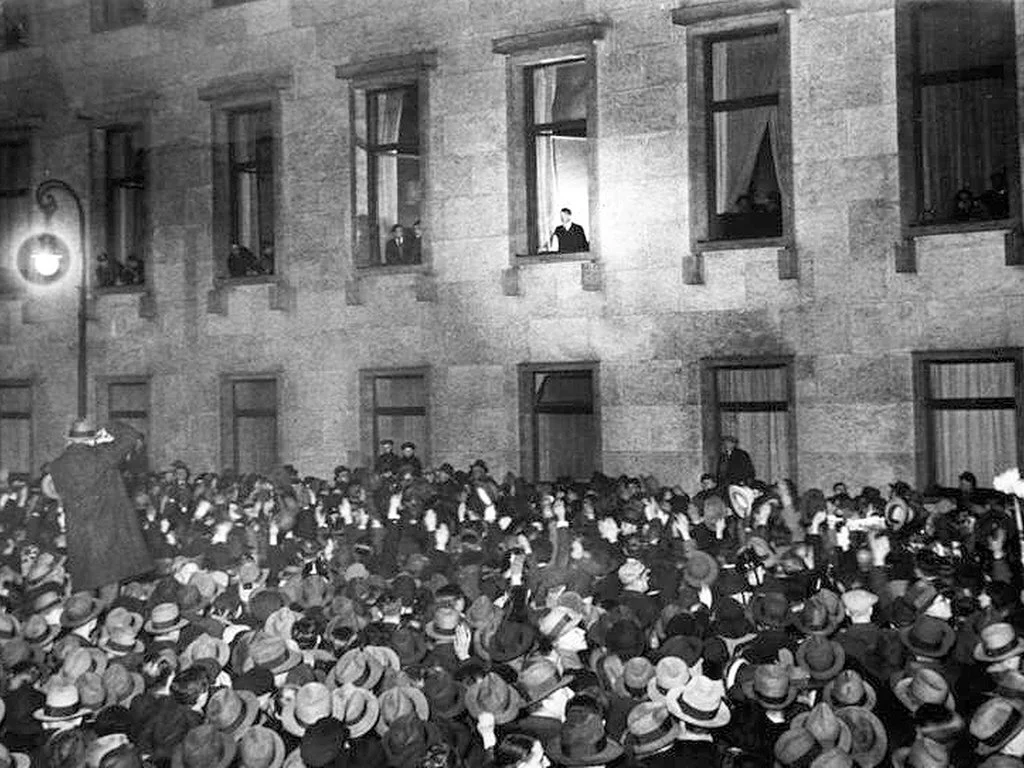
Hitler pitched in Berlin shortly after his appointment as Chancellor of Germany
The Final Days of Democracy
The period between Hitler's appointment as Chancellor and the complete Nazi takeover was a rapid dismantling of democracy:
Opponents were arrested or silenced.
The free press was gradually gagged through censorship and intimidation.
Civil liberties were curtailed in the name of "national security".
The Reichstag was sidelined as Hitler ruled by decree.
Many Germans, even those who hadn't voted Nazi, hoped Hitler would bring stability and an end to the political violence that had been plaguing the country. Few realised how fast and how far the Nazis would tear down Germany's democratic institutions.
The Reichstag Fire: Democracy's Death Blow
On February 27, 1933, less than a month after Hitler became Chancellor, the Reichstag building went up in flames. The Nazis quickly blamed the communists and used the fire as an excuse to suspend civil liberties and crush the opposition. A young Dutch communist, Marinus van der Lubbe, was arrested at the scene, but many historians believe the Nazis themselves were behind the arson.

Reichstag on fire during the night of February 27/28, 1933
The day after the fire, President Paul von Hindenburg signed the Reichstag Fire Decree, which suspended most civil liberties in Germany, including freedom of speech, freedom of the press and the right to assemble. This was the green light for the mass arrests of communists, social democrats and other Nazi opponents.
The Enabling Act followed shortly after and gave Hitler absolute power, the end of German democracy. The Weimar Republic was dead, and the Third Reich had begun.
See the aftermath: Our tour includes a visit to the rebuilt Reichstag, where you'll learn how this act of arson became a catalyst for Germany's slide into tyranny. Stand in the modern Bundestag and consider the fragility of democratic institutions.
The Debate Continues
The actual cause of the Reichstag fire is still debated among historians. The Nazi regime claimed it was the work of communist agitators; many scholars believe it was a false flag operation by the Nazis themselves. Key points of contention:
The speed of the Nazi reaction with prepared legislation.
Inconsistencies in the official version of van der Lubbe's actions.
SA men were seen entering the building before the fire.
Whatever the truth behind the fire, the Nazis used it to their advantage and crush the opposition.
Berlin: Capital of Nazi Germany
As the Nazis took power, Berlin changed. Symbols of the new regime appeared everywhere:
The swastika flag flew from government buildings and private homes.
Jewish-owned businesses were boycotted and vandalised.
Book burnings in the Opernplatz (now Bebelplatz) destroyed "un-German" literature.
The Olympic Stadium was built for the 1936 Games, a propaganda showcase for Nazi Germany.
Our tour takes you to these locations and helps you see the physical and psychological transformation of Berlin under Nazi rule.

SA men standing outside Jewish businesses to intimidate customers

Vandalism of a Jewish owned business
The Persecution Begins
As the Nazis consolidated their power, Berlin became a city of fear for many of its inhabitants. The vibrant Jewish community, which had contributed so much to the city's cultural and intellectual life, was increasingly marginalised and persecuted:
April 1, 1933, the Nazis organised a boycott of Jewish-owned businesses, with SA men standing outside shops to intimidate customers.
The "Law for the Restoration of the Professional Civil Service" on April 7, 1933, expelled Jews from government jobs.
The Nuremberg Laws of 1935 stripped Jews of their citizenship and banned marriages between Jews and people of German or related blood.
Our tour visits key locations in Berlin's Jewish history, including the site of the Great Synagogue on Oranienburger Straße, which was damaged during Kristallnacht in 1938.
The Human Cost
The Nazi persecution of Jews and other "undesirables" had a devastating effect on Berlin's social fabric:
Families were split as some members fled abroad while others stayed.
Long-standing friendships ended as non-Jews distanced themselves from their Jewish neighbours.
Talented professionals, artists and scientists were forced out of their jobs, a brain drain.
The city's cultural life was impoverished as Jewish contributions were erased or suppressed.
Our tour brings these human stories to life and helps you understand the personal tragedy behind the history.
Berlin's Cultural Revolution
The Nazis didn't just want to change the political landscape of Berlin; they also wanted to reshape its cultural life. A rigid, state-controlled cultural policy replaced the cosmopolitan, free-spirited Berlin of the Weimar years:
The Reichskulturkammer (Reich Chamber of Culture) was established to control every aspect of cultural life.
"Degenerate art" exhibitions were held to mock and stigmatise modern art.
Jazz and swing music was denounced as "Negro music" and banned.
The Underground
Despite the oppressive climate, there was still resistance in Berlin's cultural scene:
Some jazz musicians played in secret clubs.
Artists developed codes to express dissent in their work.
Writers and intellectuals met in private homes to discuss banned books and ideas.
These acts of cultural resistance may have been small, but they kept the flame of free expression alive during the darkest of times.
The Road to World War II
As Berlin became the capital of the Third Reich, it also became the hub of Nazi aggression:

Young SS recruits
The Wehrmacht High Command was based in Berlin, planning the military campaigns that would send Europe to war.
The invasion of the Soviet Union in 1941 marked a new level of Nazi Germany's war of annihilation in Eastern Europe.
The Wannsee Conference in 1942 in a villa on the outskirts of Berlin formalised the plans for the "Final Solution".
Our tour shows how Berlin became the hub of a regime that would soon threaten the world.
Military Berlin
Germany's rearmament in breach of the Treaty of Versailles was a central part of Nazi policy. Berlin was at the heart of this process:

Model of Germania. This new city hides it’s militarisation in plain sight
Secret weapons research was carried out in labs across the city.
Factories were converted for military production.
The city's infrastructure was upgraded for rapid mobilisation.
All this was hidden in plain sight and set the stage for the war to come.
Conclusion
The rise of the Third Reich in Berlin is a sobering reminder of how fragile democracy is. By visiting these sites and understanding the complexities that led to Nazi rule, we can learn valuable lessons to prevent this from ever happening again.
Berlin from 1926 to 1933 is not just a story of politics and street violence. It's a warning about economic desperation, the seduction of simple solutions to complex problems and complacency in the face of extremism.
Join our "Rise of the Third Reich" tour, walk in the footsteps of history, and experience this critical period like never before. Our expert guides will bring the past to life and show you how a democracy can fall to extremism. You'll see how individual and institutional decisions can shape the fate of a nation.
Remembering
As we visit the dark parts of Berlin's history, we are reminded of the importance of remembrance and education:
The Memorial to the Murdered Jews of Europe near the Brandenburg Gate is a place for contemplation on the Holocaust
The Topography of Terror on the site of the former SS and Gestapo headquarters has in-depth exhibitions on Nazi crimes
The German Resistance Memorial Centre is for those who risked their lives to resist the Nazi regime
All these and many more sites across Berlin are a warning of the dangers of hatred and the need to stand up for democracy and human rights.

Hitler's Bunker Berlin Location: The Ultimate Guide for History Buffs on How to Find It
Explore the eerie site of Hitler's Führerbunker in Berlin. Learn its history, how to find it today, and gain insights into the Nazi dictator's final days.
Written By Matthew Menneke

Emergency Exit of Hitler’s Bunker, July 1947

Location of the Bunker courtayrd today, 2020
For World War II history enthusiasts, few sites are as intriguing as the location of Adolf Hitler’s final days in the Führerbunker, where he spent his last moments before his suicide.
Inside Hitler’s bunker in the spring of 1945, the scene was eerie and surreal, with abandoned furniture and debris, bloodstains on the sofa, papers, an SS officer’s cap, a looted safe, and the shallow trench where the bodies of Hitler and Eva Braun were burned after their suicides. While the bunker no longer exists, you can visit where this concrete fortress once stood.
In this post, we’ll guide you to the exact location and share some fascinating facts about Hitler’s last hideout.
Where is the site of Adolf Hitler's Bunker?
The remains of the Führerbunker lie beneath a rather nondescript parking lot in central Berlin's government district. Here are the key details:
Address in Central Berlin
Gertrud-Kolmar-Straße, 10117 Berlin, Germany
Coordinates
52°30′45″N 13°22′53″E
Nearby Landmarks
Just south of the Memorial to the Murdered Jews of Europe
120 meters north of the former site of the New Reich Chancellery building on Voßstraße
A short walk from the Brandenburg Gate and the Reichstag building
The bunker's emergency exit once led to the garden of the Old Reich Chancellery, but today, that spot is occupied by the parking lot and some residential apartment buildings constructed by the East German government in the 1980s.
Visiting Hitler’s Bunker in Berlin?
See the Führerbunker site as part of our Hitler's Berlin walking tour
The bunker may be gone, but much of the history surrounding it is still visible if you know where to look. On our Hitler's Berlin – The Rise and Fall Tour, we visit the former Führerbunker site and explore the nearby locations that tell the story of the rise of Nazi Germany, the regime's crimes and its eventual destruction in 1945.
2-hour guided walking tour · Central Berlin · From €35
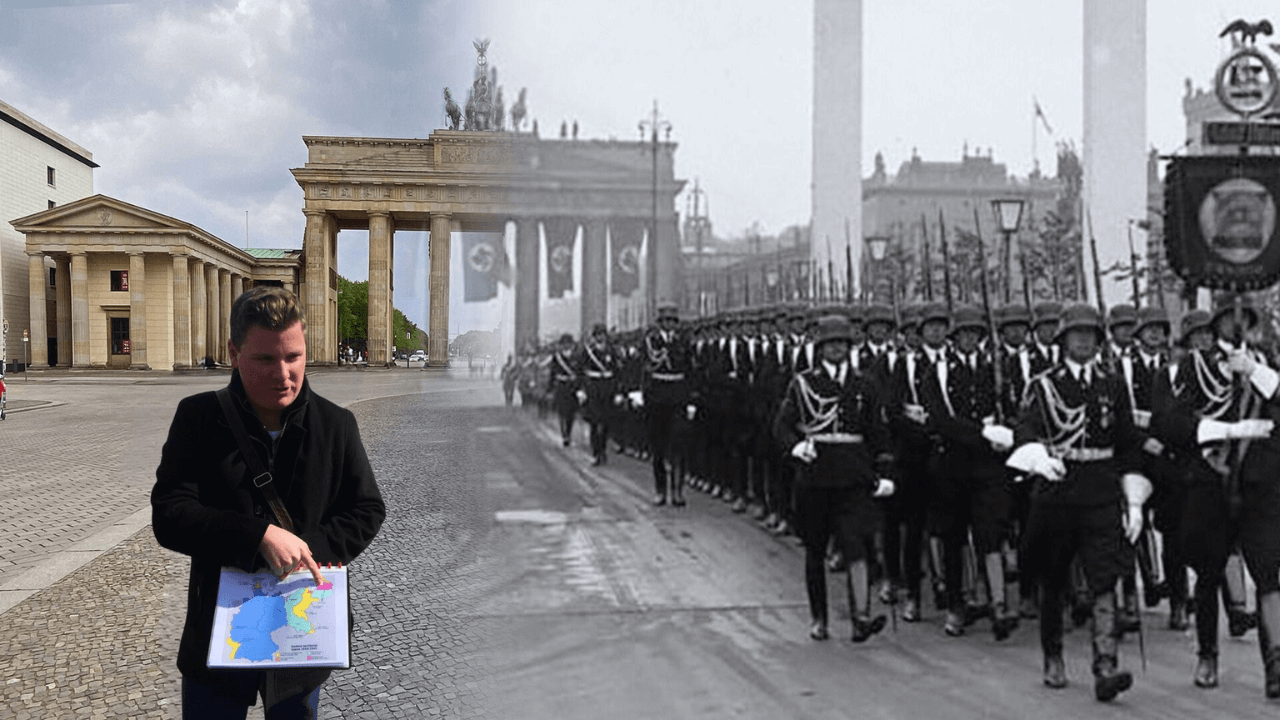
A Brief History of the Führerbunker
The Führerbunker was part of a large subterranean bunker complex constructed in two phases - a Vorbunker in 1936 and the Führerbunker proper in 1944. Some quick facts:
Located 8.5 meters (28 ft) beneath the garden of the Old Reich Chancellery
Consisted of about 30 small rooms
It had a roof up to 3 meters thick made of reinforced concrete
It included an emergency exit to the Chancellery Gardens and a connection to the Vorbunker
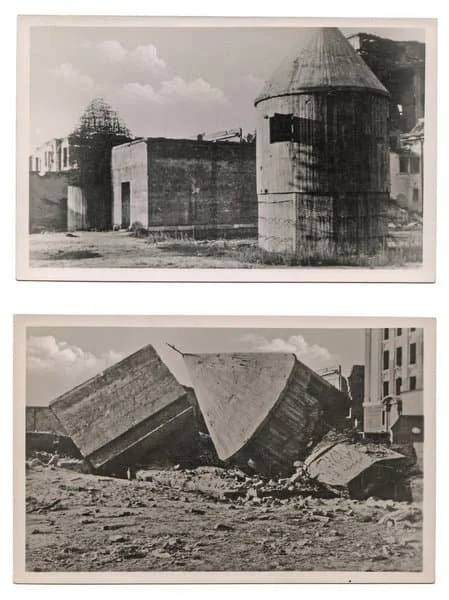
Stages of Soviet demolition in 1947.
Adolf Hitler spent the last months of his life in the Führerbunker, moving in on January 16, 1945, as the Red Army closed in on Berlin. It was here that Hitler married Eva Braun on April 29, just one day before the couple committed suicide on April 30 as the Soviet troops reached the nearby Reichstag.
According to Hitler’s instructions, the bodies were burned in a shell crater in the Chancellery garden near the bunker’s emergency exit. Today, a small information panel marks this location for visitors. Hitler’s death marked the end of the Thousand-Year Reich as Russian troops approached Berlin amidst constant bombing raids.
Finding the Führerbunker Today near the Reich Chancellery
After the war, the Soviet forces made some attempts to demolish the bunker with explosives, but much of the underground complex remained intact. The bunker was partially burned and stripped of valuables by the retreating German troops.

Guided tour my Matthew, discussing the history of the bunker

Guided tour my Matthew, showing the bunker location
However, the East German government undertook several initiatives to destroy or fill the underground rooms in the following years. The hinge of the door to Hitler's bunker was burned off by advancing Russian combat engineers.
When the area was redeveloped in the late 1980s, some sections of the old bunker complex were uncovered, but for the most part, these were destroyed. The site was intentionally left unmarked for many years.
It wasn't until 2006 that a small plaque with a schematic of the bunker was installed at the corner of In den Ministergärten and Gertrud-Kolmar-Straße. The panel provides some historical details in both German and English.
Tips for Visiting
The site is outdoors and publicly accessible 24/7, free of charge.
Closest public transport is the Mohrenstrasse U-Bahn station (U2 line) or the Brandenburger Tor station (S1, S2, S25, S26)
Combine your visit with other nearby WWII sites like the Topography of Terror museum, the Memorial to the Murdered Jews of Europe, and the Soviet War Memorial in Tiergarten.
For more context, consider joining a guided walking tour that covers Hitler's bunker and other Third Reich sites.
Layout and Interior of the Führerbunker
The Führerbunker was divided into the upper Vorbunker and the lower Führerbunker. The Vorbunker contained Hitler’s private suite, offices for his secretaries, and a guard room.
The lower level housed Hitler’s personal study, bedrooms for Hitler and Eva Braun, a conference/map room, a medical room, and quarters for high-ranking officers and staff. Hitler’s sitting room was also located on this level, where he spent much of his time during the final days.
Other key features of the bunker included:
A machine gun nest covering the main entrance
An emergency exit stairway to the Chancellery Gardens
Air raid doors that were gas-tight and had a thickness of 1.6 meters
Its own diesel power plant and air-conditioning system
A communications centre with a switchboard connecting to the outside

The diagram above provides a detailed layout of the Führerbunker complex, including the upper Vorbunker and lower Führerbunker levels.
Critical areas like Hitler’s study, the conference room, and living quarters for Hitler, Eva Braun, and other high-ranking Nazi officials are marked. The map helps visualise the claustrophobic, maze-like nature of the underground bunker where Hitler spent his final days as the war came to an end above ground.
Hitler's Final Days in the Führerbunker
As the war turned decisively against Germany in early 1945, Hitler retreated to the relative safety of the Führerbunker, where he could continue to direct the final defence of Berlin. Despite pleas from his generals to leave the doomed city, Hitler stubbornly refused, insisting that he would lead the fight to the end.

Destruction and chaos is the only description of the bunker after Hitler’s suicide

A crushed globe and a bust of Hitler amid rubble outside the ruined Reich Chancellery.
Picturing Hitler’s bunker, photographs taken inside reveal eerie scenes of ruins, abandoned furniture, bloodstains, and other haunting artifacts, providing a detailed glimpse into the last days of the Third Reich.
In the claustrophobic confines of the bunker, Hitler grew increasingly isolated and paranoid, raging against his fate and those he believed had betrayed him. Even as the end drew near, he clung to fantasies of a miraculous reversal, at one point exclaiming, “I will not leave Berlin, I will defend it! I can still win this war!”

Sifting through the debris trench where it was believed Hitler and Eva’s body’s were found

Discarded fuel cans located near the bunker
But as the Soviet troops drew ever closer and all hope of victory evaporated, Hitler finally accepted the inevitable. On April 30, 1945, with the enemy blocks away, he bid farewell to his staff and, together with Eva Braun, whom he had married just hours before, retired to his private quarters.
There, the man responsible for the most destructive war in human history took his own life, shooting himself in the head as Braun swallowed a cyanide capsule. Their bodies were hastily cremated in the shell-cratered garden above.
Myths and Conspiracy Theories Surrounding Hitler's Bunker
In the decades since Hitler's death, the Führerbunker has become a magnet for urban legends and conspiracy theories. Some claim that Hitler did not actually die in the bunker but instead escaped to South America or Antarctica. Others suggest that the bunker held occult artifacts or secret Nazi technology.

A Russian soldier stood in Adolf Hitler’s bunker, Berlin, 1945.
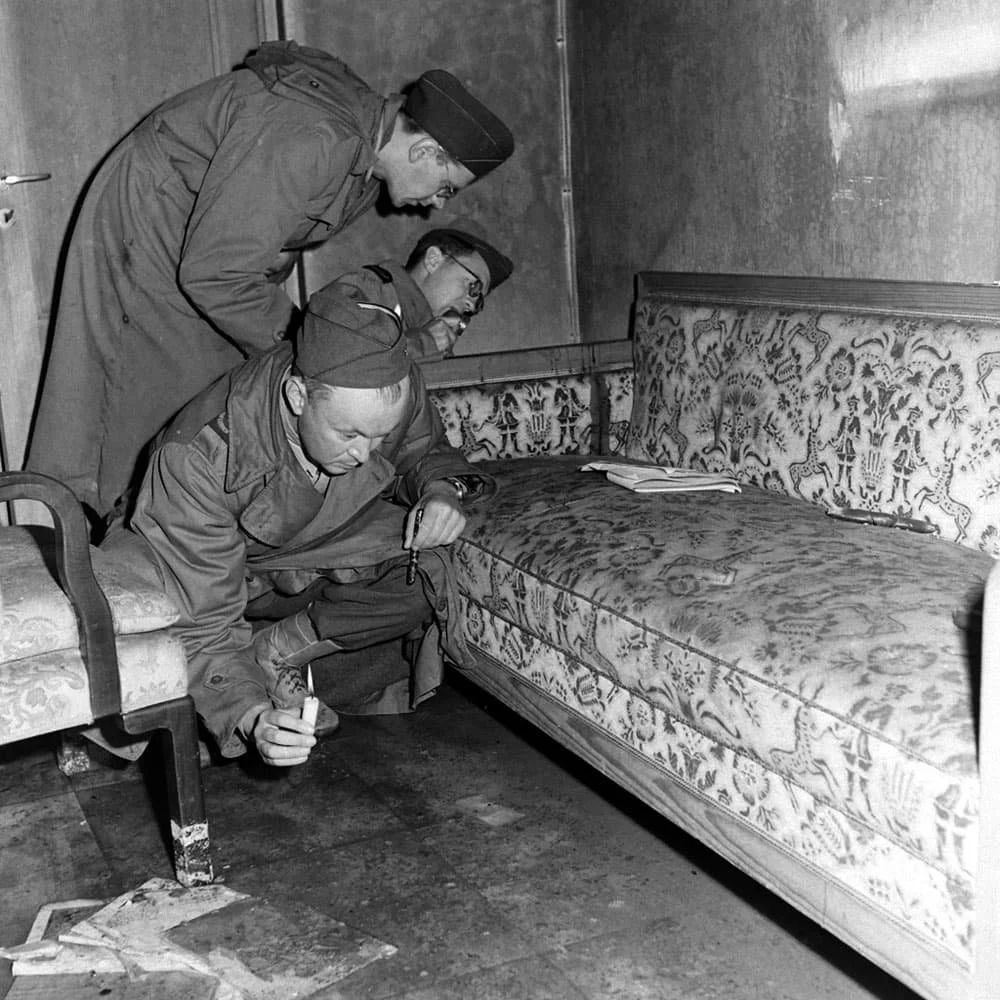
War correspondents examined a couch stained with blood located inside Hitler’s bunker.
Another popular conspiracy theory asserts that Hitler's bunker was connected via underground tunnels to the Berlin subway system, allowing high-ranking Nazis to flee the city undetected. While the bunker did have an emergency exit to the subway, there is no evidence it was used for escape or that such tunnels existed.
Despite the lack of credible evidence, these myths and conspiracies continue to capture the public imagination, a testament to the enduring fascination and revulsion surrounding one of history's most notorious figures. As long as the mysteries of Hitler's final days persist, so too will the legends and theories that swirl around his last refuge.
The Significance of the Führerbunker
For many, the site of Hitler's bunker is a sobering reminder of the evil and destruction wrought by Nazi Germany. It was here that Hitler spent his final days, increasingly detached from reality, as German and Soviet troops fought fiercely in the streets above, marking the downfall of the Third Reich.

An SS officer’s cap, with the infamous death’s-head skull emblem.
The fact that the bunker is now little more than an anonymous parking lot is, perhaps, a fitting end for a man responsible for the deaths of millions. As Berlin historian Sven Felix Kellerhoff puts it, "The National Socialists wanted to build a glorious new metropolis here, but they were only able to build an underground concrete block."
Yet even without visible ruins, the bunker's legacy looms large in the German historical consciousness. It has been the subject of numerous books, films, and documentaries, including the acclaimed 2004 film "Downfall" (Der Untergang).
The Führerbunker in Popular Culture
The Führerbunker has captured the imagination of filmmakers, writers, and game developers, featuring in numerous works of popular culture:
The 2004 German film "Downfall" (Der Untergang) offers a chilling portrayal of Hitler's final days in the bunker. The film's claustrophobic atmosphere and Bruno Ganz's haunting performance as Hitler have left an indelible mark on the public consciousness.
Other notable film appearances include "The Bunker" (1981), "The Death of Adolf Hitler" (1973), and "Speer und Er" (2005).
The Führerbunker has been a setting in video games such as Sniper Elite V2 and Call of Duty: World at War.

Der Untergang film poster
These depictions, while often dramatised for entertainment purposes, have played a significant role in shaping public perceptions of Hitler's final days and the end of World War II in Europe.
They serve as a reminder of the enduring fascination with this dark chapter in history and the ongoing efforts to understand and come to terms with the legacy of the Third Reich.
Germany's Complex Relationship with Its Nazi Past
The Führerbunker's fate also reflects Germany's complex relationship with its Nazi past. For decades after the war, many Germans preferred to ignore or downplay the country's complicity in Hitler's crimes. The bunker, like other Nazi sites, was left to decay - an unpleasant reminder best forgotten.

Nazi Party eagle that once loomed over a doorway of the Reich Chancellery, Berlin, 1945.
But as a new generation has come of age, attitudes have shifted. Many now believe that Germany must confront its history head-on, however painful that may be. The decision to leave the bunker site unmarked has come under particular scrutiny, with some arguing that it allows visitors to overlook or even deny what happened there.
Others, however, believe that the absence of any monument speaks more eloquently than a plaque or statue ever could. By refusing to glorify the bunker, they argue, Germany denies Hitler the immortality he craved and forces us to grapple with the banality of evil.
As the debate continues, the Führerbunker remains a flashpoint - a symbol of Germany's ongoing struggle to come to terms with its darkest chapter. How the country remembers this site in the years to come will say much about its relationship with the past and its vision for the future.
The Führerbunker's Enduring Legacy: From Neo-Nazi Rallies to Dark Tourism Satire
In the years since the war, the site of the Führerbunker has attracted a range of visitors, from curious tourists to neo-Nazi pilgrims. One of the most notable incidents occurred in 1987 when a group of far-right extremists attempted to stage a rally at the site on the anniversary of Hitler’s death. Police swiftly broke up the gathering, but it highlighted the enduring allure of the bunker for those who still harbour fascist sympathies.
The site has recently become a popular destination for historians and documentarians seeking to shed light on the war’s final days. In 2004, a team of researchers used ground-penetrating radar to map out the bunker’s subterranean remains, revealing the extent of the complex and the location of important rooms like Hitler’s study.

Neo-Nazi demonstration in Leipzig, Germany, in October 2009
Other visitors have included survivors of the Nazi regime, some of whom have made emotional pilgrimages to the site to confront their past. In 2013, a group of Holocaust survivors from Israel visited the bunker as part of a trip to Berlin, laying a wreath at the site in memory of those who perished under Hitler’s rule.
In the aftermath of World War II, an American soldier was photographed offering a mocking Nazi salute inside the bombed-out ruins of the Berliner Sportspalast, a site often used for Third Reich political rallies. This gesture was a disrespectful act within the historical context of the war's end.
Despite its dark history, the Führerbunker has been the scene of more lighthearted moments. In 2015, a British artist staged a tongue-in-cheek “holiday” at the site, complete with beach chairs, umbrellas, and a sign proclaiming it “Hitler’s Beach Bunker.” The installation was intended as a satirical comment on the commercialisation of dark tourism.
As the years pass and the living memory of the war fades, the Führerbunker is likely to remain a magnet for those seeking to understand one of history’s darkest chapters. While the site may be unassuming, its legacy continues to loom large in the world’s imagination.
The Contrasting Fates of Notorious Führer Sites
The Führerbunker's understated fate stands in stark contrast to other notorious Nazi sites like the Wolf's Lair and the Eagle's Nest.
Hitler's Eastern Front military headquarters, the Wolf's Lair:
Heavily damaged by retreating German forces
It still attracts thousands of visitors each year
Features extensive ruins and a museum examining the 1944 assassination attempt on Hitler

Hitler's reinforced bunker at the Wolfsschanze
The Eagle's Nest, Hitler's mountaintop retreat in Bavaria:
Captured largely intact by American troops
It turned into a tourist destination
Visitors can tour the lavish complex and take in panoramic views of the Alps

The Eagles Nest
The differing approaches to these sites reflect the complexities of preserving dark heritage:
Some argue that places like the Wolf's Lair and Eagle's Nest provide valuable historical insights.
Others worry that they risk glorifying the Nazi regime.
The Führerbunker, in its unassuming anonymity, sidesteps this dilemma but raises its own questions about remembrance and erasure.
Ultimately, there is no easy answer for dealing with the physical remnants of a painful past. But by grappling openly with these challenges, as Germany continues to do, we can learn from history's darkest chapters and build a more just future.
Further Reading and Resources
For those interested in delving deeper into the history of Hitler's bunker and its role in the final days of World War II, consider exploring these additional resources:
"The Bunker" by James P. O'Donnell - This classic book, based on interviews with survivors, provides a gripping account of the last days in the Führerbunker.
"Inside Hitler's Bunker: The Last Days of the Third Reich" by Joachim Fest - Renowned historian Fest offers a meticulously researched and vividly written chronicle of the bunker's final chapter.
"Berlin: The Downfall 1945" by Antony Beevor - While not solely focused on the Führerbunker, Beevor's acclaimed book gives a comprehensive overview of the Battle of Berlin and the regime's collapse.
The German Resistance Memorial Center - Located in Berlin, this museum is dedicated to those who fought against the Nazi regime, including the July 20 plotters who attempted to assassinate Hitler at the Wolf's Lair.
Conclusion
A pilgrimage to the site of Hitler's bunker is a must for any WWII history buff visiting Berlin. While the bunker itself is long gone, standing where the Führer met his ignominious end is a powerful experience that brings the war's final days to vivid life.
By understanding what happened in this small patch of Berlin real estate, we can better grasp the magnitude of the conflict that reshaped the 20th century - and honour the memory of the millions who suffered under Hitler's brutal regime.
Explore the history on the ground
If you're visiting Berlin and want to understand what happened here beyond simply finding the bunker location, join us on our Hitler's Berlin – The Rise and Fall Tour.
Walk through the former government district with an expert guide and explore the locations connected to Hitler's rise to power, the Nazi dictatorship and the final collapse of the Third Reich in 1945.
2 hours · Central Berlin · From €35

The article was written by Matthew Menneke.
Matt is the founder and guide of 'On the Front Tours', offering military history tours in Berlin. Born in Melbourne, Australia, Matt's passion for history led him to serve in the Australian Army Reserve for eight years. With a degree in International Politics and a successful sales career, he discovered his love for guiding while working as a tour guide in Australia. Since moving to Berlin in 2015, Matt has combined his enthusiasm for history and guiding by creating immersive tours that bring the past to life for his guests.

The Battle of Berlin: The Final Blow to Hitler's Third Reich
The Battle of Berlin in 1945 was the final major offensive in Europe, marking the end of World War II.
Introduction:
In the spring of 1945, as the Second World War in Europe drew to a close, the once-mighty German Reich lay in ruins. The Soviet Red Army, having turned the tide of the war in the East, stood poised on the banks of the Oder River, ready to strike the final blow against Nazi Germany. Their target: Berlin, the capital and heart of Hitler's crumbling empire. The Battle of Berlin, which raged from April 16 to May 2, 1945, would be the last major offensive in Europe and the death knell for the Third Reich.
The battle was a culmination of years of bitter fighting between Germany and the Soviet Union, a titanic clash of ideologies and armies that had left millions dead and reshaped the map of Europe. For Stalin and the Soviet leadership, the capture of Berlin was not just a military objective but a matter of national pride and vengeance for the immense suffering inflicted on their country by Hitler's invasion. For the Germans, the defence of their capital was a desperate last stand, a fight to the finish in which surrender was not an option.

Soviet tanks advance through Berlin
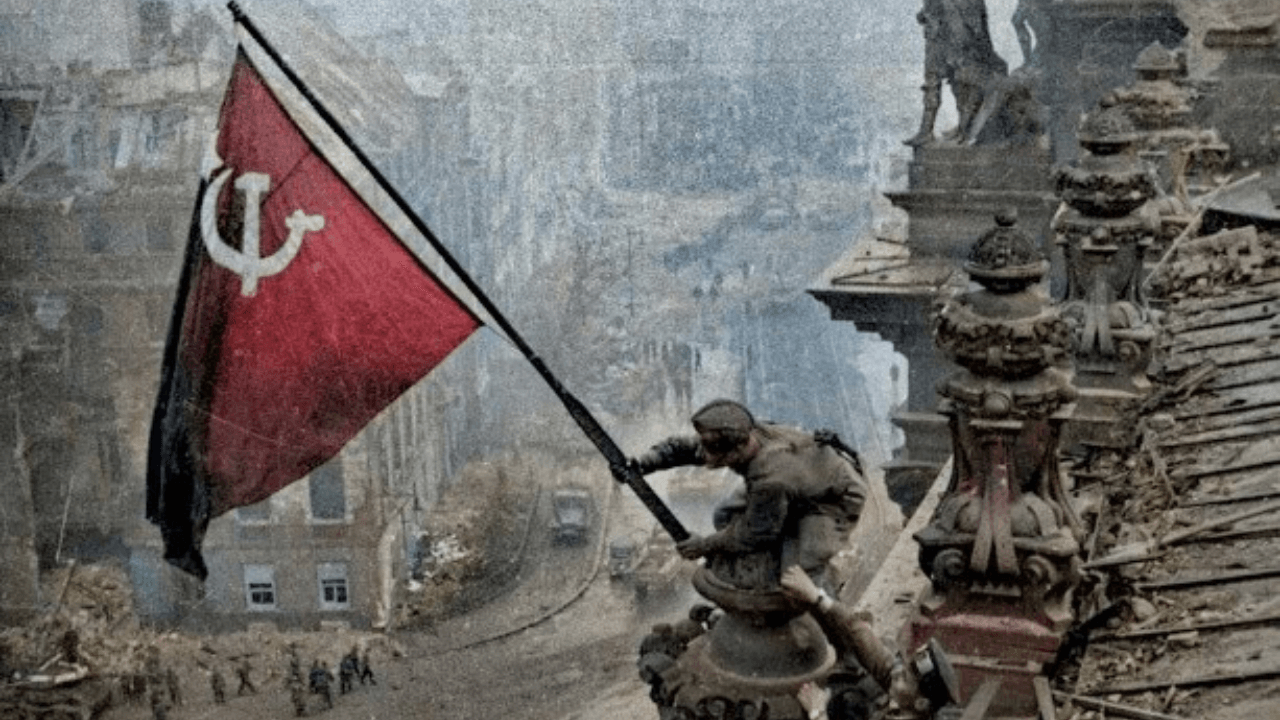
Battle of Berlin - Battlefield Tour
The Importance of Berlin:
Berlin in 1945 was not just the administrative capital of Germany but the symbolic heart of the Nazi regime. It was here that Adolf Hitler rose to power in the early 1930s, consolidating his grip on the nation and transforming Germany into a totalitarian state. The city was a showcase for the grandiose vision of the Third Reich, with wide boulevards, massive government buildings, and imposing monuments designed to project an image of strength, power, and permanence. Berlin was the nerve centre of the Nazi war machine, home to the regime's top leaders and decision-makers.
But Berlin was more than just a political capital - it was also a crucial industrial and transportation hub. The city's factories churned out a steady stream of weapons, vehicles, and other supplies to feed the voracious appetite of the German military. Berlin's extensive rail network and its position at the crossroads of Europe made it a vital link in the supply chain that sustained the Nazi war effort on multiple fronts.
As the Red Army approached Berlin in April 1945, the city took on an even greater significance. For the Soviets, capturing Berlin would be the ultimate prize, a way to avenge the staggering toll of 26 million Soviet citizens killed in the war and to assert their dominance in postwar Europe. Stalin was determined to take the city before his Western allies, advancing from the other direction. The Soviet leader knew that whoever controlled Berlin would have a major say in the future of Germany and the continent as a whole.
For Hitler and the Nazi leadership, the fall of Berlin would mean the end of their "Thousand Year Reich." The Führer had ordered the city to be defended to the last man, vowing never to leave the capital alive. He and his top lieutenants retreated to a bunker deep beneath the Reich Chancellery, directing the city's defences and clinging to increasingly unrealistic hopes of a last-minute reprieve. Hitler's propaganda minister, Joseph Goebbels, called on Berliners to fight to the death, warning that the Soviets would unleash a wave of destruction and atrocities if they took the city.
The Bleak Situation for the German Army:

The frontlines in late April 1945
As the Soviet forces prepared for their final offensive, the situation for the German Army was dire. The Wehrmacht, once the pride of the Third Reich, was a shadow of its former self. Years of continuous warfare had depleted its ranks, and the relentless Allied bombing campaigns had shattered its industrial base, making it increasingly difficult to replace lost equipment and personnel.
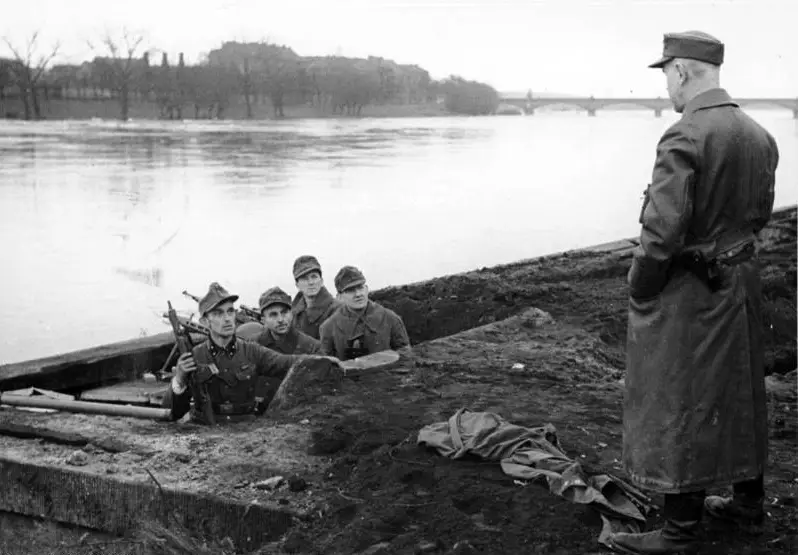
German soldiers dug in along the Oder river
The German High Command was acutely aware of the desperate situation. Resources were scarce; the troops were often young, inexperienced, or elderly men hastily conscripted from the Volkssturm, a national militia. The once-feared Panzer divisions were now few in number, and many tanks were old or in disrepair. Fuel shortages meant that even those that were operational could not be effectively deployed.
Despite these challenges, the German Army prepared to defend Berlin with a grim determination. General Helmuth Weidling, the commander of the Berlin Defense Area, organized the city's defences, knowing full well that there would be no reinforcements. The strategy was to turn Berlin into a fortress, with barricades, anti-tank obstacles, and fortified positions throughout the city. Civilians, including women and children, were pressed into service to dig trenches and build defences.
The German soldiers, many of whom were aware that they were fighting a losing battle, were motivated by a combination of fear, loyalty, and the knowledge that surrender to the Soviets could mean death or harsh captivity. Propaganda played a role as well, with Nazi officials exhorting the troops to fight to the last man to protect their homeland from the perceived barbarism of the advancing Red Army.
The German Army, under-equipped and outnumbered, faced the overwhelming might of the Soviet juggernaut. The stage was set for a brutal, no-quarter struggle that would reduce much of central Berlin to rubble. The battle for Berlin would not only determine the fate of the city but would also seal the fate of the Third Reich.

Seelow Heights Battlefield Tour
The Soviet Offensive:
The Soviet assault on Berlin codenamed "Operation Berlin," was a monumental military undertaking that involved some 2.5 million soldiers from the 1st Belorussian Front under the command of the renowned Marshal Georgy Zhukov and the 1st Ukrainian Front led by the equally formidable Marshal Ivan Konev. This massive force was supported by an awe-inspiring array of military hardware, including 6,250 tanks, 7,500 aircraft, and a staggering 41,600 artillery pieces. It was, by any measure, one of the largest and most complex military operations ever undertaken in the history of warfare.

Soviet artillery firing on German positions, 3 am April 16 1945
The offensive began on April 16 with a massive, earth-shaking bombardment of the German defences along the Oder-Neisse line. The sky lit up with the flash of thousands of guns, and the ground trembled under the weight of the explosive barrage. Zhukov's forces, the hammer of the Soviet offensive, attacked from the centre and north, while Konev's men, the anvil, hit the German lines from the south. Despite fierce and determined resistance from the outnumbered and outgunned Germans, who fought with the desperation of men who knew they were the last line of defence for their capital, the Soviets managed to break through. Slowly, inexorably, they pushed the defenders back towards the outskirts of Berlin.
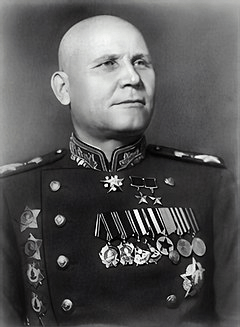
Marshal Ivan Konev
“It is we who shall take Berlin, and we will take it before the Allies.” - Six Meetings that Changed the 20th Century (2007)

Marshal Georgy Zhukov
“The longer the battle lasts the more force we'll have to use!” - A History of the Modern Age (1971)
In these opening days, one of the most critical and brutal battles was the fight for the Seelow Heights, a heavily fortified area east of Berlin that represented the last major obstacle before the city itself. Here, the Germans had constructed three formidable defensive lines bristling with trenches, anti-tank ditches, and extensive minefields. The battle raged for four long, bloody days, with the Soviets suffering heavy casualties as they threw themselves against the German defences. German guns cut down wave after wave of Soviet infantry and armour. However, still, they came on, driven by a combination of courage, desperation, and the implacable will of their commanders. Finally, on April 19, after a titanic struggle that left the ground littered with the dead and dying, the Soviets overran the last German positions on the heights, and the road to Berlin lay open.
The Battle for the City:
As the Soviet troops entered the outskirts of Berlin, they faced determined, even fanatical resistance from a hodgepodge of Wehrmacht and Waffen-SS units, Hitler Youth, and Volkssturm militia. The city had been turned into a fortress, with streets barricaded, buildings fortified, and critical intersections turned into strong points bristling with machine guns, anti-tank weapons, and panzerfaust-wielding defenders. The Soviets had to fight for every block and building in brutal, close-quarters combat, clearing out cellars and attics with grenades and flamethrowers and engaging in hand-to-hand fighting in the rubble-strewn streets.
One of the most iconic and symbolic moments of the battle came on April 30, when Soviet troops stormed the Reichstag, the historic parliament building that had been the seat of German power. The fighting was fierce and unrelenting, with the Soviets having to clear the building room by room, floor by floor, in a deadly game of cat and mouse with the die-hard German defenders. Snipers, machine guns, and booby traps took a heavy toll on the attackers, but they pressed on with grim determination. Finally, as the sun began to set on the evening of May 1, a group of Soviet soldiers managed to fight their way to the roof of the shattered building and raise the Soviet flag over the Reichstag, a red banner fluttering in the smoke-filled air. It was a moment of immense symbolic significance, signalling to the world that the heart of Nazi Germany had fallen and that the end of the war in Europe was at hand.

Soviet T-34 engaged in battle along a Berlin street

Staged Soviet photograph showing a sniper position
Meanwhile, in his dank, claustrophobic bunker deep beneath the Reich Chancellery, Adolf Hitler, the once all-powerful Führer of the Third Reich, lived out his final, desperate days. As the Soviet troops drew ever closer, the sounds of battle echoing through the concrete walls, Hitler, his mind and body ravaged by disease and despair, prepared for the end. In a hastily arranged ceremony, he married his longtime mistress Eva Braun, and then, on April 30, as Soviet soldiers fought their way into the Chancellery garden above, Hitler and Braun committed suicide, the Führer shooting himself in the head while his bride took poison. Their bodies were hastily cremated in a makeshift pyre in the Chancellery garden, a grim and ignominious end to the man who had once dreamed of conquering the world and establishing a thousand-year Reich.
Hitler’s Berlin - the rise and fall
Aftermath and Legacy:
The Battle of Berlin, which raged from April 16 to May 2, 1945, ended with the unconditional surrender of the city's remaining defenders. The once-proud capital of the Third Reich lay in ruins, its streets littered with debris and the bodies of the fallen. The human cost of this final, decisive battle had been staggering: over 80,000 Soviet soldiers were killed, and more than 250,000 were wounded in the fierce fighting. German losses, both military and civilian, numbered in the tens of thousands. The civilian population of Berlin also suffered terribly, with countless thousands killed in the crossfire or by suicide as the Red Army closed in.

Soviet soldiers celebrate the fall of Berlin

White flags flow from windows - symbolising total surrender
The fall of Berlin marked the effective end of the Third Reich. With Hitler dead by his own hand in his underground bunker and the country occupied by Allied forces, the German High Command had no choice but to agree to unconditional surrender. The final capitulation came on May 8, 1945, bringing an end to the war in Europe and the nightmare of Nazi tyranny that had plagued the continent for six long years.
The battle also had far-reaching political consequences that would shape history for decades to come. The Soviet capture of Berlin, ahead of their Western allies, gave Stalin a significant bargaining chip in the following postwar negotiations. The division of Germany and Berlin into Soviet and Western zones of occupation set the stage for the Cold War, which would dominate global politics for the next four decades. The Iron Curtain that divided Europe into communist and capitalist spheres was born in the ruins of Berlin.
Today, the Battle of Berlin stands as a warning to the immense destructive power of modern warfare and the depths of human suffering it can cause. The scale of the fighting, the devastation wrought on the city, and the sheer loss of life on all sides serve as a grim reminder of the horrors of war. At the same time, the battle also serves as a tribute to the courage and sacrifice of those who fought to end the tyranny of Nazi Germany and bring peace back to Europe. The soldiers of the Red Army, who bore the brunt of the fighting and suffered the heaviest losses, showed incredible bravery and determination in the face of fierce resistance from a fanatical enemy.

Allied victory parade July 1945
The scars of the battle can still be seen in the streets and buildings of Berlin, a city that has risen from the ashes to become a symbol of resilience and renewal. The bullet holes and shrapnel marks on the facades of old buildings, the memorials to the fallen, and the museums dedicated to the history of the war all serve as reminders of the city's painful past. But Berlin has also become a vibrant, multicultural metropolis, a hub of art, culture, and innovation that looks to the future with hope and optimism.
In the end, the legacy of the Battle of Berlin is a complex one, marked by both tragedy and triumph. It represents the end of one of the darkest chapters in human history but also the beginning of a new era of peace, democracy, and international cooperation. As we reflect on the events of those fateful days in April and May 1945, we must remember the sacrifices made by those who fought and dedicate ourselves to the cause of building a world free from the scourge of war.
Conclusion:

Clearing the ravished streets of Berlin
The Battle of Berlin was the final cataclysmic act in the European theatre of World War II. It pitted the full might of the Soviet war machine against the fanatical but crumbling defences of the Third Reich in a struggle for the very heart of Germany. The battle left the city in ruins and cost tens of thousands of lives, but it also brought an end to the Nazi regime and its dreams of conquest and racial supremacy. Today, as we mark the 75th anniversary of this historic event, we remember the courage and sacrifice of those who fought and died in the battle, and we renew our commitment to building a world of peace and understanding.
The article was written by Matthew Menneke.
Matt is the founder and guide of 'On the Front Tours', offering military history tours in Berlin. Born in Melbourne, Australia, Matt's passion for history led him to serve in the Australian Army Reserve for eight years. With a degree in International Politics and a successful sales career, he discovered his love for guiding while working as a tour guide in Australia. Since moving to Berlin in 2015, Matt has combined his enthusiasm for history and guiding by creating immersive tours that bring the past to life for his guests.