

The American capture of the Bridge at Remagen
Hello and welcome to the On the Front blog, where we discuss all things military history and I take you to these sites today.
In today’s blog we are going to discuss the battle for the Remagen Bridge
This bridge has quite a remarkable story. Both the Allies and the Germans tried to destroy it and despite taking heavy damage from both sides, the bridge would remain standing. Tragically as we will discuss later, coming down on its own on the 25th of March 1945.
The Remagen Bridge is called the Ludendorff Bridge named after the German General Erich Ludendorff. Built in 1916, to supply German troops on the Western Front during the First World War. The bridge was built during war time and to protect it against capture, the bridge engineers pre-drilled holes at strategic points, so if the bridge was to fall into enemy hands it could be easily destroyed. Following the end of the First World War the Rhineland was demilitarised and the French took control of the area and filling these pre-drilled holes in with concrete.
In 1936, Hitler retook the Rhineland and control of the Ludendorff bridge, marching German soldiers into the demilitarised zone, a flamboyant violation of the Versailles Treaty but neither the French or the British had any desire to try and stop Hitler out of fear it could start another war.

German troops reoccupy the Rheinland.
In perhaps a sign of things to come, in 1938, the bridge had 60 zinc lined boxes attached to strategic points, each box capable of containing 3kg of explosives, the system was designed to detonate all at once. It was expected, by pre-preparing the bridge for demolition, it would require minimal preparation should the bridge need to be destroyed.
Several bridges were prepared in such a way and on October 14th, 1944, the Mulheim Bridge in Cologne was destroyed after an American bomb hit one of these pre-prepared explosive box’s setting of a chain reaction destroying the bridge. Enraged by this mishap, Hitler ordered the engineers responsible for the bridges wiring to be court-martialled and all pre-prepared explosives on other German bridges be disarmed and the explosives stored nearby.
New orders meant bridges were only to be re-wired when the enemy were within a certain distance (8km) and only to be destroyed by written order. The new orders created a lot of confusion and fear amongst German engineers who were afraid of being court-martialled. This is important in explaining why the Ludendorff bridge was still intact when the American 9th Armoured Division arrived at Remagen.
By March of 1945, the German Armies in the west were in complete disarray. The failed push through the Ardennes in the Battle of the Bulge, cost the Germans greatly in manpower and equipment but showed they were not yet ready to surrender and remained a formidable and dangerous enemy. Hitler irrationally refused any retreat and for the German Armies to recapture lost territories west of the Rhine. This left German units scattered in an often-untenable position to stop the allied advance. Those who could, fell back across the Rhine River, this natural obstacle had acted as a traditional defence against enemy invasion from the west as far back as the Roman invasions 2,000 years prior.
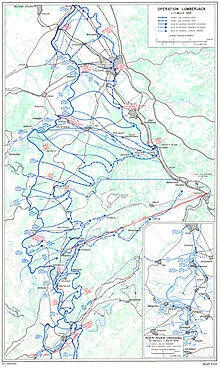
Operation Lumberjack
Operation Lumberjack was the US operation to capture the key cities of Cologne and Koblenz. Once they had reached the Rhine though, US forces where to hold their positions while British Field Marshal Bernhard Montgomery launched Operation Plunder, a meticulously planned operation to cross the Rhine in the North.
As luck would have it though, it would be the US that would cross the Rhine first.
The 9th Armoured Division of the US First Army was tasked with scouting the town of Remagen. Nicknamed the “Phantom” division as the unit had been repeatedly reported by the Germans to have been destroyed encountered weak and sporadic resistance.
On the morning of March 7, Lt. Col. Leonard Engeman was stunned to look through his binoculars and see the Ludendorff bridge still intact with German troops of the 15th Army still retreating across. Lt. Karl Timmermann, who had been born in Frankfurt, Germany in 1921 was tasked with leading an advance force, which included some of the new M26 Pershing tanks, into the town to capture the bridge.

Lt. Timmerman
German resistance on the towns outskirts was fierce and made Timmermans progress slow. Eventually reaching the foot of the bridge around 3:15pm in the afternoon. As US forces began to make their way across, German engineers detonated the bridge explosives. The bridge shook tremendously and plumes of smoke lifted in the air, but the bridge remained intact.

Sgt. Dabrik
Multiple explanations have been given as to why the bridge was not destroyed. We know not all of the explosive detonated and whether or not this was because of poor explosives, the bridge having been wired, un-wired and re-wired or perhaps good old-fashioned luck, we will never know.
The explosions though did render the bridge impassable to tanks and Timmerman along with his infantry sprinted across the bridge cutting wires wherever they saw them to prevent any further detonation attempts. Sergeant Alexander A. Drabik was the first American and first foreign soldier since Napoleons Armies to cross the Rhine. Once across the US established a bridgehead and engineers got to working repairing the damage to allow the tanks to cross.
The situation for the Germans was chaotic at best. Last minute changes in command and the capture of the General Rothkirch the commander of defences at Remagen had accidentally wandered into US lines the night before.
The bridge commander Captain Bratge, commanded a group of 1,000 poorly trained and ill-equipped soldiers. The bulk of the force was made up of 500 Volksturm, the rest were 180 Hitler Youth, 125 engineers, 200 Luftwaffe ground crew together with other patched together infantry units.

Maj. Scheller
Command of the bridge was given to Maj. Scheller who arrived at 11:20am, a few hours before the Americans. As US forces approached the bridge, Batge wanted to blow the bridge but needed written approval from Scheller who was at ground level trying to co-ordinate a cohesive defence. Even trying to convince mixed units still crossing in retreat to stay and defend the bridge but most sped away.
Scheller realised the situation was hopeless and began preparation for detonation but a young Lt. Karl Peters begged for more time to allow his anti-aircraft crews which were equipped with the new and top secret Henschel Hs 297 rocket launchers to cross, so as not to allow these weapons to fall into the hands of the US.
Once across, Captain Karl Friesenhahn the chief engineer responsible for the detonation requested written permission from Batge but he could not provide the order as he had not yet received the written order from Scheller. This fastidious attention to detail bought the Americans crucial time who by the time the written order had been received were already on the bridge.

Inside the Remagen tunnel
Once the US were across the bulk of the German force took refuge in the tunnel along with hundreds of civilians from the town. US troops threw in grenades and fired into the tunnel accidentally killing and wounding civilians. Pressure from the towns people to surrender ultimately lead Batge to surrender.
Scheller, escaped through the rear of the tunnel and travelled by bike to the German command centre informing them the bridge had fallen intact. Hitler was outraged and put together kangaroo courts to court-martial those thought to be responsible. Maj. Scheller was sentenced to death and executed for failing to destroy the bridge, although he had only arrived on the scene 2 hours before the US forces. Lt Karl Peter’s was also executed, although he was nothing more than a passer-by trying to get his experimental anti-aircraft guns across the bridge. It was claimed his delay in crossing hindered the bridges detonation. Capt Batge was sentenced to death in absentia, as he had surrendered to the Americans.
The executions sent shock waves through the Wehrmacht and even saw German soldiers blow up bridges unnecessarily even destroying bridges important to the Germans own war effort as they were fearful of execution if the bridges were to fall into enemy hands.

US anti-aircraft defences at Remagen
In the ten days following the capture of the Ludendorff bridge, Hitler ordered it to be destroyed and the German military threw everything they had at it. Counter attacks to retake the bridge failed miserably. US intelligence intercepted German communications which seemed to signify a large troop build-up but these forces where only sizeable on paper. The severely weakened German forces only managed to put together mixed units. These units suffered unnecessary casualties and result in over 11,000 German troops being captured.
The German Luftwaffe led multiple air-raids to destroy the bridge including the use of the Messerschmitt 262A, the first jet powered aircraft to no avail. Desperate to destroy the bridge, Hitler approved the use of the V2 rockets which landed as close as 200 meters. The US mounted their largest anti-aircraft defense of the entire war to protect the bridge with 5 anti-aircraft battalions.
The Karl-Gerät 60 cm mortar was fired on the bridge on March 20 without any effect. Even attempts to float barges filled with explosives down the river failed.
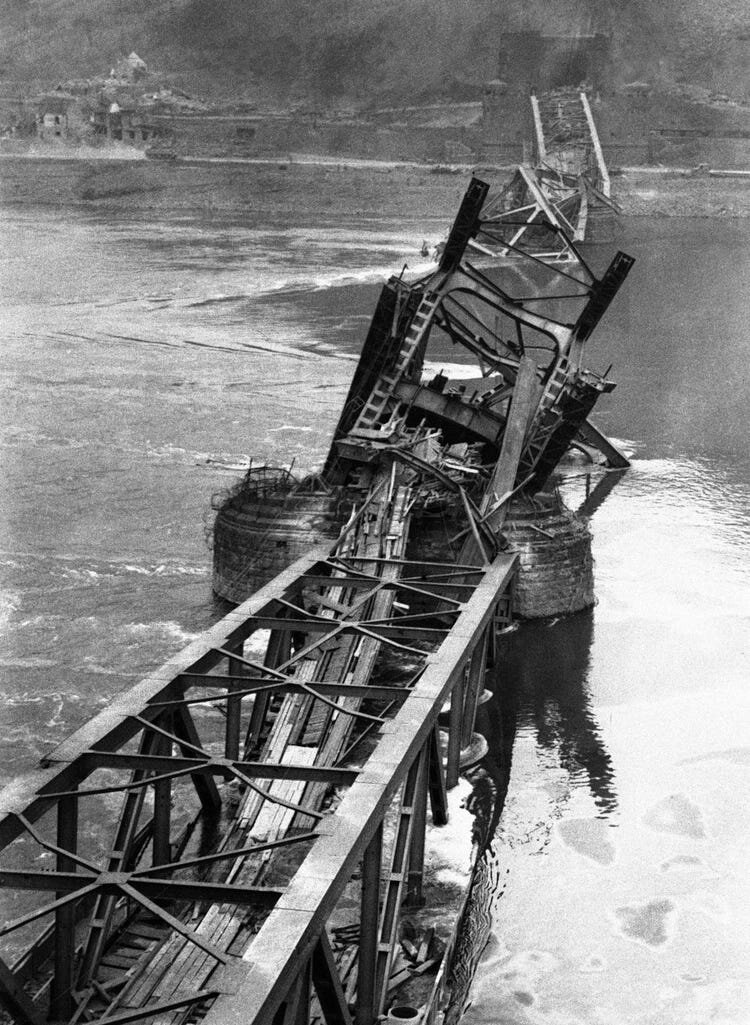
Collapsed Ludendorff Bridge
The bridge would ultimately collapse on the 17th of March, 1945, as the result of metal fatigue from the strain of the allied advance and relentless bombing, weakened the bridge. The collapse resulted in the deaths of 33 US engineers and injured 63 soldiers who were on the bridge at the time.
By this time though the bridge had served its purpose. By the time the bridge collapsed US engineers had built two heavy adjoining steel bridges and were able to advance 25,000 troops across the Rhine and capture over 19,000 German soldiers before the breakout on March 25th.
The resulting capture of the Ludendorff bridge has led both US and German military authorities to agree the capture of the bridge shortened the war. The Ludendorff bridge was not rebuilt after the Second World War and all that remains of the site today are the twin towers on either side. On the western bank is a museum detailing the battle for the bridge with a strong emphasis on peace.

Ludendorff Bridge today
Let me know your thoughts about the battle for the Remagen Bridge, do you think its capture shortened the war?
Thank you for reading and if you liked this post hit that like button and if you want more content from me remember to subscribe and I’ll see you next time On the Front.

Nazi Temple Of Doom - The Real Castle Wolfenstein
Hello and welcome to the On the Front blog, where we discuss all things WWII.
In this blog we are going to discuss the Wewelsburg Castle, in town of Wewelsburg, Westphalia, Germany. This castle often referred to as the Nazi Temple of Doom and was the inspiration behind the popular Castle Wolfenstein video game. So what is the mystery surrounding this castle?
The castle itself was thought by Heinrich Himmler the leader of the SS to have mystic powers and was to be turned into the spiritual Mecca for the Nazi occult. A place for the 12 SS department heads and other SS elite to meet and prepare themselves spiritually for future assignments. This purpose though was never fully realised and only two such meetings actually took place. The last between 12-15th of June 1941, one week before the launch of Operation Barbarossa code name for the invasion of the Soviet Union. At the meeting Himmler told his generals the aim of the campaign was to eliminate some 30 million Slavs; the Nazi regime would come tragically close to this number.
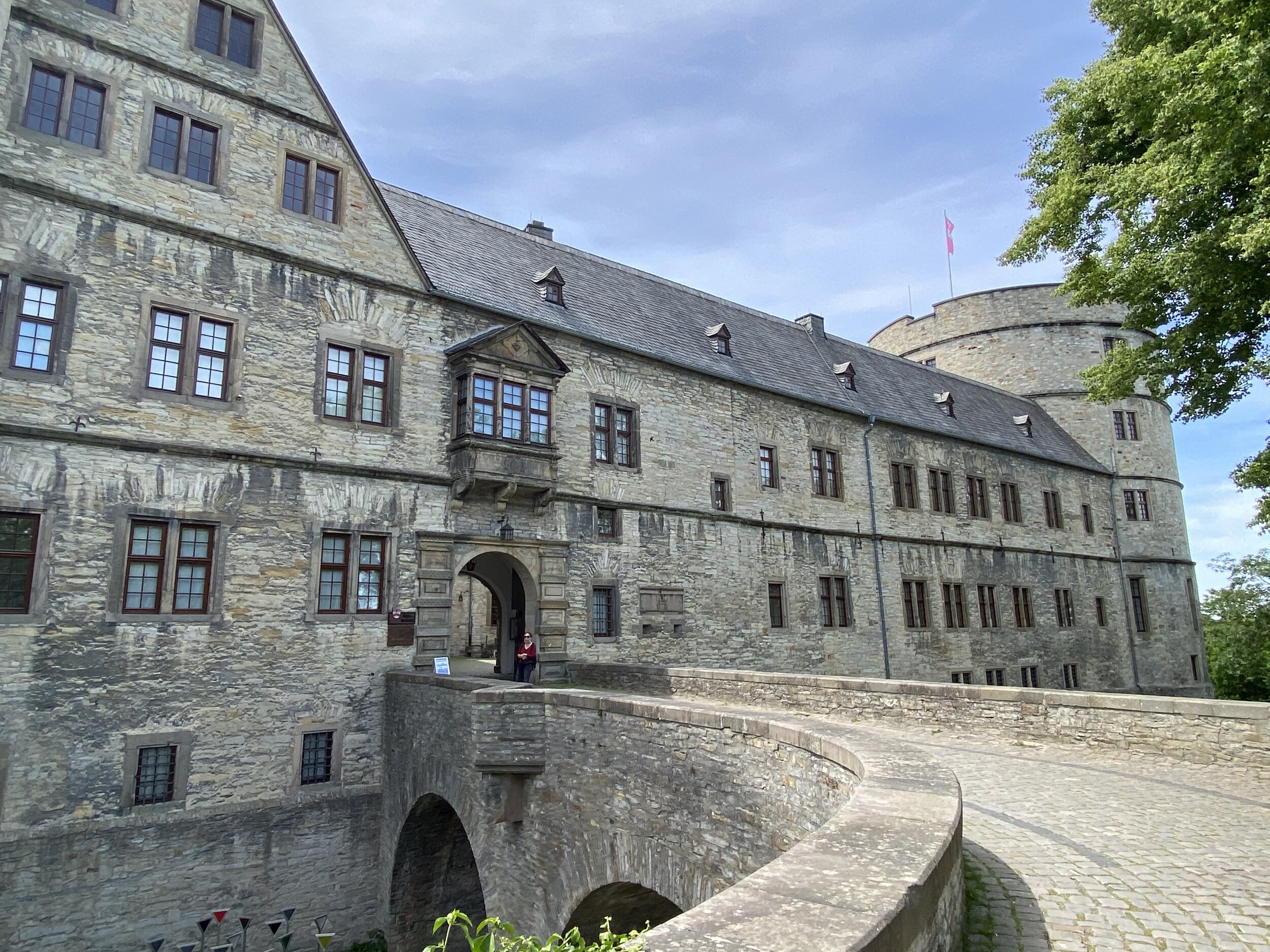
Wewelsburg Castle entrance
Wewelsburg Castle foundations date back to the Middles Ages. As the site stands today, the castle design dates to the 17th century. The castle is located near the Teutoburg Forest. The {then} believed the site where Arminus, a Germanic tribe leader defeated the Roman Army which in part lends the castle to ancient fantasy. For the last 75 years the castle has exuded a dark fascination luring Satanists and Neo-Nazi’s alike drawn in by pagan symbology and Nazi occultism making this site a kind of sadistic pilgrimage.
Much of the pseudo-religious mystery that has surrounded this castle since 1945 of torch-lit ceremonies, ancient Nordic and pagan rituals and the mythos of the Ancient Aryan is all fake.
So, where do these rumours come from?

Himmler laying a wreath in Wewelsburg Castle
Much of the rumours stem from Himmler’s own delusional understanding and interpretation of Germanic and Nordic mythology. He was fascinated by prophecy, magical power and the belief that the Aryans were a super race. The SS was designed to be the very embodiment of this belief.
Himmler desperately wanted a facility where he could drum these values into future SS leaders. Acquired in 1934, Himmler leased the property for 100 years at the symbolic rental price of 1 Reichsmark per year. Initially he planned to turn the facility into a leadership school for SS officers’, but this later changed, and it was designed as a meeting point for the SS elite.
The focus of the Wewelsburg Castle was to research pseudo-scientific theories of Germanic pre- and early history, medieval history, folklore and genealogy. All of this was intended to provide the underpinnings for the racial teachings of the SS. Vast archaeological excavation sites sprung up here and at other important sites such as the Externsteine, a place of Christian worship that was thought by the Nazi’s to have been a pagan place of worship.

German soldiers posing for a photo at the Externsteine
So, what did they discover? In a word; Nothing.
All theories put forward by Nazi archaeologists didn’t stand up to scrutiny and only through intimidation and suppression of academia were any of these theories able to be published. The lack of evidence didn’t stop Himmler though, if he couldn’t find the archaeology, he would fake it.
A lot of work was put into acquiring ancient artefacts such as the Spear of Destiny, in an Indiana Jones style collecting spree. Even the Castles architecture is fake. Construction of mystic meeting halls inspired by tales of King Arthur and the Knights of the Round table had the 17th century plaster ripped from the walls and replaced with stone cladding to give the interior a more medieval feel.
The arches in the "Hall of Generals" may look medieval, but the pillars are made of concrete. It's an extraordinary example of how Himmler tried to falsify and recreate history to justify their own pseudo-religious ideology. Like much of the Nazi pomp and extravagance when you peak behind the curtain, there is nothing there.

Hall of Generals
The exact nature of any rituals that were performed here is unknown. Historians are certain though that no pagan rituals to evoke Nordic gods or anything of the like took place. The Nazi party in the years after taking power would find themselves butting heads with the Christian church and used their newly discovered fake archaeology to support their push for Germans to move away from traditional Christian celebrations and instead to celebrate pagan inspired Nazi occultism even creating their own Christmas and marriage celebrations.
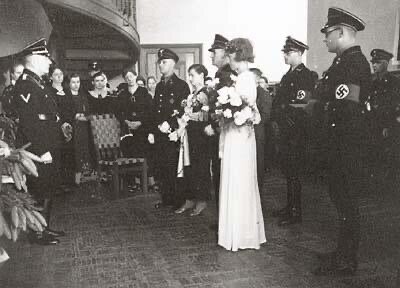
Nazi wedding ceremony conducted at Wewelsburg Castle
In the twelve years Himmler had ownership of the castle this intended pseudo-religious site did play host to several marriages and swearing in ceremonies for the SS generals. Also stored here were the SS Honour Rings of fallen comrades. They were stored in a chest in the castles crypt, to symbolise the ongoing membership of the deceased SS members. In all 11.500 rings were kept here but no one knows what happened to them after the war. Rumour has it that they are buried in a nearby mountain.
Himmler’s dreams for the castle were never fully realised. His aims for turning the site into the spiritual centre for the new world of the Nazi ideology following the “final victory”, saw the castle design take on monolithic proportions. So grand were his plans that it was intended that the Wewelburg towns people be relocated to the newly conquered Lebensraum in the east and the town flooded.
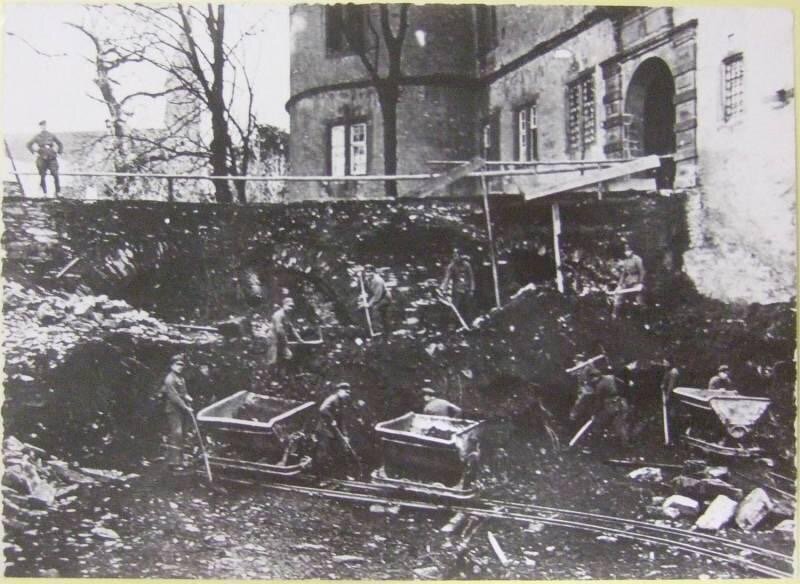
Concentration camp prisoners working at Wewelsburg Castle digging
Construction of the site began using labours from the Freiwillige Arbeitsdeints but the outbreak of the Second World War saw these workers conscripted into the military and a more sinister contruction method was used. Himmler had a purpose-built concentration camp for the castle’s construction. Over 3,900 prisoners worked on the project. The working conditions were so horrible that the Wewelsburg camp had staggeringly high mortality rate with at least 1,229 people dying of exhaustion, ill treatment or execution. After the defeat at Stalingrad, construction at the Wewelsburg castle stopped. A new decree required all nonessential construction projects not contributing to the war effort were to be ceased and the site was left to 42 prisoners and SS guards.
Shortly before the end of the war, Himmler ordered the castle be destroyed. SS Maj. Hainz Macher along with 15 soldiers destroyed much of the site with explosives and anti-tank mines. What remained standing was set on fire and in the days that followed the site was extensively looted. The medieval exterior though survived and two rooms in the north tower have been preserved as structural remains of Nazi architecture. The “Crypt” and the Hall of the Supreme SS Leaders showing the sun wheel motif in the floor are original.
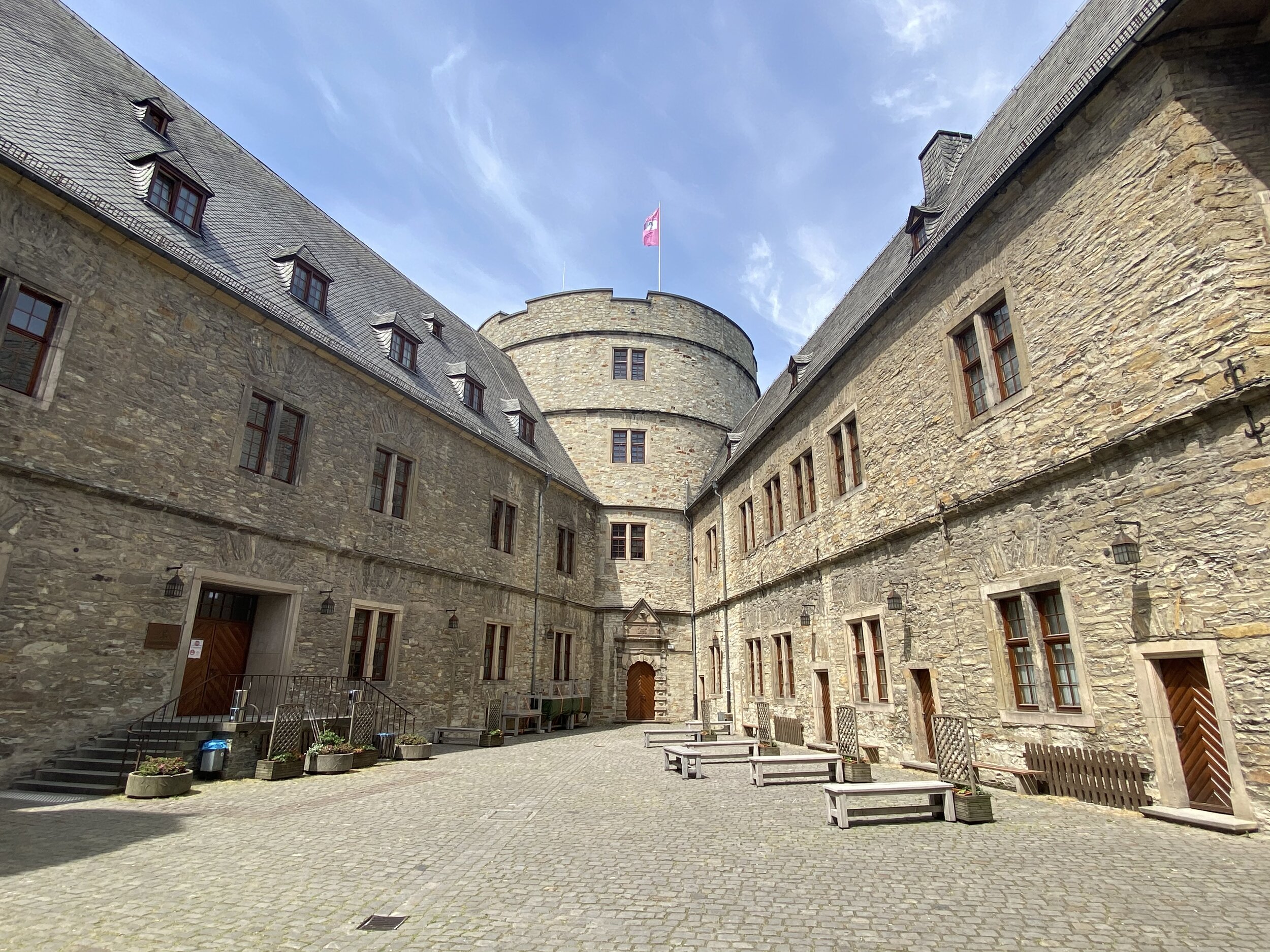
Interior courtyard. To the left is the hostel entrance.
On March 31,1945 the site and the concentration camp was liberated by the US 3rd Armoured Division. Reconstruction of the castle began in 1948 and in 1950 was re-opened as a museum and youth hostel. Today the entire site is a war monument, the museum is located in the former SS guard house in the castle forecourt. If you would like to stay here the Youth hostel is still in operation.
Would you stay here? Let me know your thoughts in those comments down below and what you think of the Nazi Temple of Doom.
Thank you for reading and if you liked this article hit that like button and I’ll see you next time On the Front.

Nazi Wonder Weapons the V-1 and V-2 Rockets
Hello and welcome to the On the Front blog, where we discuss all things WW2
In today’s blog we are going to discuss the Peenemünde Army Research centre. This facility produced the world’s most technologically advanced weapon systems, touted as wonder weapons by Adolf Hitler. What were these weapons? The V1 and V2 rockets.
Development of the Penemünde site began in 1936 and was completed in one year using the forced labour of concentration camp prisoners. The site would continuously be developed resulting in the facility eventually having its own dedicated concentration camp. The site itself consisted of an airport, a Seaport, a series of productions facilities, hundreds of apartment building for the thousands of scientists, multiple missile launch pads, a powerplant and wind tunnel capable of reaching speeds of Mach 4.4.The site grew so large in fact that it needed its own railway network which became the third largest rail network in Germany behind Berlin and Hamburg.
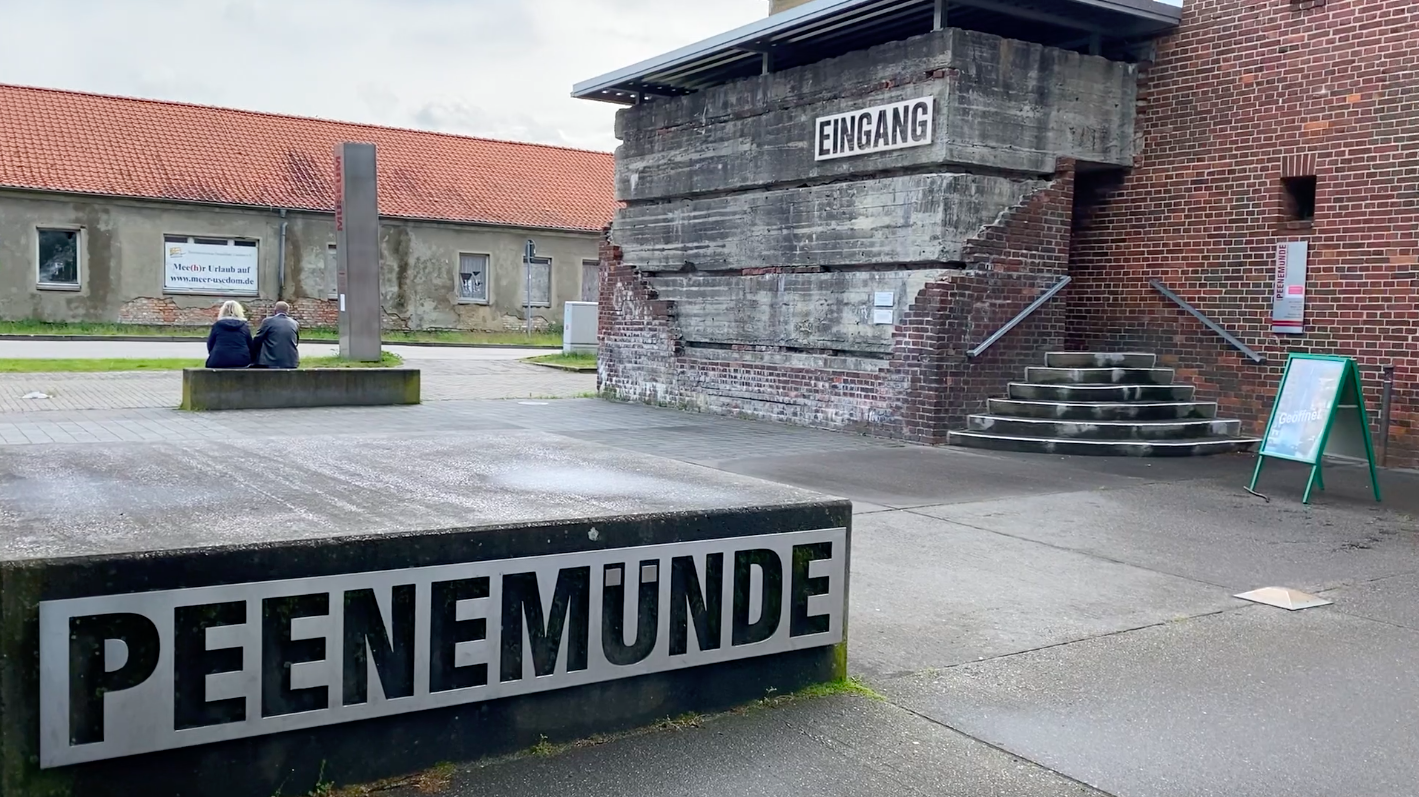
Peenemunde site entrance

Powerplant and location of present museum
The power plant is the only section of the facility that survives in its original condition. The plant was used by the Soviets up until 1990 to power the East German power grid. Everything else was destroyed by the Soviets as part of their agreement with the Allies. There are a number of bunkers scattered around if you have the time to wonder the grounds of this huge site.
V-1 Flying Bomb

V1 Flying bomb
Development of the V1 began in 1939 and was the first incarnation of the vengeance weapons that were developed by the Nazi’s. Code named Kirschhern (Cherry Stone) the V-1’s would later be nicknamed Doodlebugs by Londoners because of the iconic sound they would make.
Testing for the V-1 began in early 1941 but they would not be put into action until June 13th, 1944 one week after the successful allied landings at Normandy. Their target was London, the first V-1 hit Grove Road, Mile End in South London. At its peak 100 V-1’s were fired at London every day in events which became known as the second Blitz.

V1 Flying Bomb display at Peenemunde facility
The V-1 carried an 850kg warhead and was propelled off of a launch track. Guided by a simple compass heading the V-1 was equipped with a front censor which calculated how far it had flown and after the distance was up the engines would cut off and it would nosedive into the ground. The result of this simple to calculate trajectory made the rockets easy to shoot down. RAF fighter squadrons tasks with destroying the V-1’s before they came over London would on occasion to save ammunition use their wing tips to knock the V-1 off course which would cause the missiles too loose control and crash early in empty fields or over the Channel.
The limited range of the V-1 meant they were fired from launch sites on the French and Dutch coast lines. The V-1 attacks over England ceased in October 1944 as the allies made their way further inland and overran the launch sites within range of the English Isles. After this the V-1’s were targeted elsewhere with the last V-1 attack occurring on March 29, 1945.
V-2 A4 Rocket

V2 Rocket on display at Peenemunde facility
The granddaddy to all modern cruise missiles the V-2 weapon system would lay the groundwork to putting the first man on the moon. Development of the V-2 began in 1941 and was the upgrade to the V-1. During its development Hitler was not impressed by the rocket describing it as an artillery shell with a longer range and greater cost.
Able to carry a 1 tonne war head, the V-2 was enormously sophisticated. Controlled by an onboard gyroscope to regulate trajectory the V-2 would leave the Earth’s atmosphere (the first rocket ever able to do so) and then free fall at supersonic speed onto its target making it impossible to defend against. Modern air Défense systems would still find it difficult to shoot a V-2 down once it made its decent.
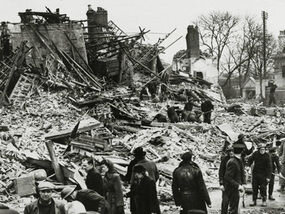
Londoner’s in the aftermath of a rocket attack
As the war dragged on Hitler needed a morale booster for the German people and approved the development of the V2 touting it as a Wonder Weapon to win the war. In total 3,000 V-2’s were constructed and fired at targets in London, Antwerp and Liege. The bombings would result in 12,000 civilian deaths.
The construction of these weapons fell to concentration camp prisoners. The terrible working conditions at the manufacturing facilities related to production of the V-2 resulted in the deaths of over 20,000 inmates. It is the only weapon ever built to result in more deaths during construction then in action.

RAF reconnaissance photo of Test Stand VII
Penemünde was the development site of the V-Series rockets until 1943 when it became the target of British and US bombers during Operation Crossbow. Two Polish janitors at the facility managed to sneak out maps detailing the area. As part of operation Hydra, in August 1943, the first bombers made their pass, initially targeting the research facilities living and housing quarters to kill the scientists at the facility.

Wernher Von Braun surrounded by Wehrmacht officers
Nazi high command became concerned over the venerability of the site and moved the development and manufacturing of the weapons to Mittlewerk an underground manufacturing site in Kohnstein central Germany. Penemünde remained in operation but only as a testing site. The facility was captured by Soviet soldiers of the 2nd Belorussian Front on May 5th, 1945. The facility had long been abandoned and strategic installations destroyed.
Development of the V-Series weapons was the responsibility of Wernher Von Braun a young mechanical engineer who became fascinated by the writing of Hermann Oberth a pioneer in the development of rocket technology and space travel theorist.

Wernher Von Braun with US President Kennedy
After the war Von Braun surrendered to the Americans. He and 1,600 other German scientists were secretly moved to the United States as part of Operation Paperclip. A secret program used to boost the US in the Space race against the Soviet Union.
The Soviets too recruited German scientists but in a more aggressive way forcibly moving 6,000 German scientists including their families at gun point to Russian rocket facilities.
Von Braun along with other German scientist would be eventually be recruited to NASA in the 1960’s. Von Braun worked on the Apollo Program was the chief architect behind the Saturn V Super Heavy Launch Vehicle the propelled the Apollo spacecraft to the moon.
The V-Series weapons were touted as Wonder Weapons by Hitler that would win the war for Germany but in truth these expensive weapons had very little impact. In fact, researchers now believe these and other “Wonder Weapons” may have even expedited Germany’s surrender as their development and production starved the German Wehrmacht of valuable and vital recourses.
Let me know your thoughts about Hitler’s V1 and V2 wonder weapons in the comments below. Thank you for reading and I’ll see you next time On the Front.

Abandoned Nazi Mega Structure. Hitlers holiday resort
Hello and welcome to the On the Front blog, where we discuss all things WW2.
In this blog, I am going to discuss the Colosuss Prora resort. This Nazi era building complex is located on the island of Rügen, in northern Germany. Built between 1936 and 1939 the complex was designed as a holiday beach resort through the Kraft durch Freude KdF (Strength Through Joy) project. Designed for 20,000 guests, this 4.5km long Nazi mega structure is the longest building complex in the world. Consisting of eight identical buildings 150m from the beach. The surviving structures stretch a whopping 3km.
The Strength Through Joy project was a state initiative founded in November 1933 to provide working class Germans with affordable holiday opportunities which initially were only available to the middle and upper classes. The project was operated in conjunction with the state propaganda ministry and allowed Germany’s poorest access to Theatre tickets, hiking and day trips. By 1937 some 9.6 million Germans had taken part in a Strength Through Joy excursion.

Holiday makers apart of the KdF program
In cooperation with the Italian dictatorship Strength Through Joy also offered international travel to the Italian Riviera and skiing holidays in the Italian Alps. The project was a huge success selling some 45 million tours by the outbreak of WWII.
The construction of Prora was an ambitious project. Hitler insisted that all rooms were to have a sea view. Plans were made for a gigantic celebration hall supposedly able to house all 20,000 guests at the same time. There were two wave pools, a theatre and a cinema. Costing an astounding 237.5 million Reichsmarks (57 Million Euros today), the project was never realised, construction grinned to a halt at the outbreak of WWII.

Abandoned section of Prora resort
During the war the empty complex was used as a place to shelter during air raids, emergency housing for refugees and accommodation for female auxiliary personnel for the Luftwaffe.
In 1945, the Soviet Army took control of the site and turned it into a military base, stripping the buildings of any value. The soviets demolished large sections of the Northern and southern building complexes. In the 1950’s, control of the site was given to the East German Government (Deutsche Demokratische Republik. DDR) and with the creation of the National Peoples Army (National Volks Army. NVA) in 1956 the building was turned into a military barracks. The surviving interior décor which can be seen still in its un-renovated state today.

Last remaining original sections under going renovation
Following German reunification in 1990 the NVA was folded into the West German Bundeswehr and the site would continue to serve as a military barracks for a short time. From 1992 -“94, the complex was transformed to a refugee centre and housed asylum seekers from the Balkans.
For the remainder of the 90’s the complex was largely abandoned except for use as a museum, exhibition centre and art gallery. Unsuccessful attempts to sell the site resulted in a Government backed initiative to convert part of the complex into a youth hostel, making it the largest youth hostel in Europe.
In 2004, it was decided to sell the site in sections with multiple investors buying up large sections and plans were approved in 2008 to turn the site into its original intended purpose of a holiday resort.

Renovated sections of Prora resort
Criticism from locals who felt there were already too many tourists in the region or that the sites history made in inappropriate for tourism development were overruled and the revamped Youth Hostel with over 400 beds (Germany largest youth hotel) opened in 2011. Further development by multiple investors has breathed new life into the complex with the site now housing a luxury hotel, shopping centre and art gallery. Several blocks have also been converted into luxury apartments marketed as holiday homes. These beach apartments can also be found for long and short rental on multiple online booking platforms.
Let me know your thoughts about Prora resort and if you would book a stay in any of the accommodation in the comments below. Thank you for reading and I’ll see you next time On the Front.