

What Was The Third Reich?: Berlin's Dark Transformation 1926-1933
Berlin's transformation from 1926-1933: Nazi rise to power through propaganda, violence, and economic crisis. A city's fall into tyranny and the birth of the Third Reich.
Berlin's streets hide secrets of a wild past where democracy fell and tyranny rose. From 1926 to 1933, the Nazi Party took power and transformed not just the German capital but the whole of the German Reich and the world. Follow us as we explore the key events, people and places that shaped this period and the steps that led to one of humanity's darkest hours.
Berlin in the late 1920s was a city of contradictions and growing unease. The city was a hotbed of culture and liberal thinking and simultaneously economic hardship and political chaos after the First World War. The Weimar Republic, Germany's fragile democracy, struggled to keep the lid on rising extremism from the left and right. Into this volatile mix, the Nazi Party, led by Adolf Hitler, was looking to spread its influence beyond its Bavarian heartland. Berlin, a city that was largely hostile to Nazi ideology, was the prize, and the task fell to a man who would become the master of propaganda and manipulation: Joseph Goebbels.
Key Terms and Definitions
Before we get into the transformation of Berlin, it's good to understand some key terms and concepts:
Third Reich: Literally "Third Empire" or "Third Realm", this refers to Nazi Germany from 1933 to 1945, seen as a successor to the Holy Roman Empire and the German Empire of 1871-1918. The Nazis used this term to mean a new powerful German state.
Nazi Party: Short for National Socialist German Workers' Party (Nationalsozialistische Deutsche Arbeiterpartei or NSDAP), a far-right political party led by Adolf Hitler. Founded in 1920, it rose to power in the 1930s and became the ruling party of Germany.
Nazi Government: The political regime led by Adolf Hitler and the Nazi Party from 1933 to 1945 was characterised by totalitarian control, aggressive expansionism and the implementation of Nazi ideology.
Weimar Republic: The unofficial name for Germany from 1919 to 1933, a democratic regime established after World War I and before Nazi rule. Named after the city where the constitution was drafted, the Weimar Republic faced many challenges, including economic instability and political extremism.
Propaganda: Information, especially of a biased or misleading nature, used to promote a political cause or point of view. A vital tool in the Nazi rise to power. The Nazis used various forms of propaganda, including radio broadcasts, films, posters and mass rallies to spread their ideology and maintain control.
Antisemitism: Prejudice, hostility or discrimination against Jews. A core tenet of Nazi ideology that would lead to the Holocaust. Antisemitism had deep roots in European history, but the Nazis took it to unprecedented extremes implementing policies of persecution and, ultimately, genocide.
Totalitarianism: A system of government that is centralised and dictatorial, requiring complete subservience to the state. Under Nazi rule, Germany became a totalitarian state, with the government controlling nearly every aspect of citizens' lives.
Gleichschaltung: A Nazi policy of forced coordination and synchronisation of all aspects of society, including politics, culture and the economy to align with Nazi ideology.
Lebensraum: Literally "living space", the Nazis used this concept to justify territorial expansion, particularly in Eastern Europe, to provide land and resources for the German people.
Führer: German for "leader" or "guide" This title was adopted by Adolf Hitler as the supreme leader of Nazi Germany, combining the roles of Chancellor and President.
Gestapo: Short for Geheime Staatspolizei (Secret State Police), this was the official secret police of Nazi Germany known for its brutal methods and role in suppressing opposition to the regime.
These will give you context for what happened in Berlin during this period. They are the ideological framework, political structure and societal changes of Nazi Germany and its capital. As we look at Berlin's transformation, these will help us understand the impact of the Nazi regime on the city and its people.
Joseph Goebbels: The Man Who Would Shape Nazi Berlin
On a cold November day in 1926, 29-year-old Joseph Goebbels stepped off a train at Anhalter Bahnhof with a task that seemed impossible: to win Berlin for the Nazis. The city, as Mark Twain called it, "the Chicago of Europe", was a city of many political ideologies, from communists to social democrats to monarchists.

Joseph Goebbels

NSDAP regional office in Berlin, Potsdamer Straße.
Goebbels' first stop was Potsdamer Straße 109, the Nazi Party headquarters. The basement office, nicknamed the "opium den", was smoky and stank of stale beer – not exactly the most promising start for a movement with big plans. But it was from here that Goebbels would launch a campaign of propaganda and violence that would bring Berlin under Nazi control.
Goebbels' Plan: Propaganda and Intimidation
To turn the Nazi's fortunes into "the reddest city in Europe after Moscow", Goebbels used a two-pronged approach that would become a Nazi staple:
Propaganda
Street violence
Key points:
Reorganise party leadership to get rid of internal opposition
Make provocative public speeches that played on people's fears and resentments, based on the Nazi ideology called for the elimination of 'racially inferior' peoples and the establishment of Aryan supremacy.
Mobilise the SA (Sturmabteilung) to intimidate and attack political opponents.
Use modern technology like radio and film for mass communication.
Goebbels, a failed novelist with a PhD in literature, knew the power of words and images. He created a narrative of German victimhood and Nazi salvation that many disaffected citizens would buy into.
The Art of Speech
Goebbels was a great orator; he could get crowds excited with his speeches. He knew the power of repetition and simplicity. His speeches often focused on:
The "stab-in-the-back" myth is that internal enemies caused Germany's defeat in WWI.
The threat of "Jewish-Bolshevism" to German culture and society.
The promise of a strong Germany under Nazi leadership.
These were carefully staged affairs, with dramatic lighting, music, and crowd control to create a religious atmosphere. Goebbels knew politics was as much about emotion as it was about policy.
The Pharussäle Incident: Violence Breaks Out

Pharussäle beer hall Post Card
On February 11, 1927, Goebbels' strategy paid off. At the Pharussäle beer hall in Wedding, a working-class district of Berlin, a Nazi rally turned into a violent fight with communist protesters. The SA, led by the brutal Kurt Daluege, beat back the opposition with brass knuckles and rubber truncheons. Goebbels spun the event into a propaganda victory, with the Nazis as heroes against "red terror".
After Pharussäle
The Pharussäle incident was a turning point in the Nazi's Berlin strategy. It showed they were willing to use violence to get what they wanted and could control the narrative through propaganda. In the days after the fight, Goebbels' newspaper Der Angriff (The Attack) published sensationalised stories of communist brutality and Nazi heroism.

Der Angriff (The Attack) Newsletter
This also energised Nazi supporters who saw themselves as soldiers in a political war. The SA, in particular, grew in numbers and audacity after Pharussäle and more and more violent clashes with political opponents on Berlin's streets.
Economic Crisis: Perfect Storm for Extremism
The late 1920s were a time of economic collapse in Germany:
Hyperinflation destroyed the German economy, wiped out savings and undermined democratic institutions.
The 1929 Wall Street Crash triggered a global depression that hit Germany hard.
By 1932, unemployment in Berlin was 600,000, and breadlines and soup kitchens were familiar sights.
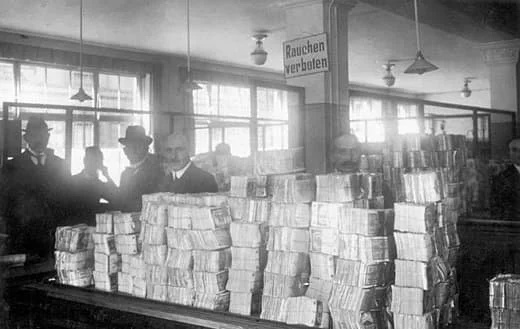
Piles of worthless inflated Reichsmarks
It was desperation time. Families were being evicted from their homes, and once proud workers were begging on street corners. This economic chaos was the perfect breeding ground for extremist movements promising simple solutions to complex problems.
The Human Toll of Economic Collapse
The economic crisis of the late 1920s and early 1930s had a daily impact on life in Berlin:
Families had to sell their belongings to buy basic necessities.
Children went to school hungry and couldn't concentrate.
Suicide rates soared, especially among the middle class, who had lost everything.
Crime rates increased as people turned to theft and prostitution to survive.
These conditions created a sense of hopelessness and anger, and the Nazis were quick to capitalise on it. They offered not just economic solutions but scapegoats for Germany's problems.
The Nazis' "Socialism of Action"
Goebbels took advantage of this and launched a "Socialism of Action" campaign. Party members opened their homes to the unemployed and offered hot soup and a sense of belonging. Nazi welfare organisations like the National Socialist People's Welfare (NSV) provided food, clothing and medical care to those in need – but only to "racially pure" Germans.
This worked even on die-hard communists who saw the Nazis as the only ones doing something to help. Of course, the ultimate goal was not charity but a dependent population loyal to the Nazi cause.
Walk in their footsteps: Our tours take you through the working-class neighbourhoods where the Nazis' empty promises of economic salvation found willing ears. See the buildings where soup kitchens operated and hear the stories of those who were seduced by Nazi propaganda.

“Our last Hope: Hitler” - propaganda poster
The Dark Side of Nazi Charity
While the Nazis' welfare programmes provided relief to many Germans, they also had a darker purpose. These programmes were used to:
Gather information on individuals and families for future use.
Brainwash recipients with Nazi ideology.
Exclusion and further marginalise groups deemed "unworthy" by the regime.
The NSV, in particular, was instrumental in implementing Nazi racial policies, deciding who was worthy of assistance based on racial and political criteria. This seemingly charitable organisation would later be complicit in some of the regime's worst atrocities.
The Beer Hall Putsch: A Turning Point in Nazi Tactics
The Nazi Party's rise to power in Berlin was influenced by the lessons of the Beer Hall Putsch in Munich in 1923. Hitler's failed attempt to seize power by force led to his arrest and the temporary ban of the Nazi Party. However, it also gave them valuable experience that would inform their future strategy and ultimately lead to their rise to power in Germany.

Hitler pitched with esteemed General Ludendorf during the Beer Hall Putch Trial
The failed putsch was a turning point for Hitler and his followers, forcing them to re-evaluate their strategy and long-term goals. Here are the lessons they drew from this experience:
The rule of law: After his release from prison, Hitler decided to get power through apparently legal means, manipulating the democratic system rather than overthrowing it. This change of approach allowed the Nazis to operate within the Weimar Republic while working to undermine it from within.
Martyrdom: The failed putsch allowed the Nazis to present themselves as persecuted patriots, those who died in the attempt as party martyrs. This narrative of sacrifice and dedication to the cause became a powerful tool for recruitment and propaganda, appealing to national pride and victimhood.
The breadth of support: The putsch's failure showed the need for a mass movement and support from key institutions like the military and big business. Hitler realised that to succeed, the party had to extend its appeal beyond its core base and build alliances with influential parts of German society.
Propaganda: The events surrounding the putsch demonstrated the power of media coverage and public perception. This led to an increased focus on propaganda and message control, with Joseph Goebbels later becoming the master of Nazi propaganda.
Timing: The failed coup taught Hitler and his followers the importance of waiting for the right moment to strike. They learned to be patient and opportunistic, capitalising on crises and public discontent to advance their agenda.

Soldier’s in the streets during the Beer Hall Putsch
In Berlin, Goebbels put these lessons into practice with brutal effectiveness. The party focused on propaganda, electoral politics and the gradual penetration of existing power structures. The SA's violent tactics were now balanced with a layer of respectability, allowing the Nazis to appeal to a broader base while still intimidating their opponents.
The Nazis' new approach in Berlin included:
Massive rallies and parades to show off their strength and popularity.
Using modern technology like radio and film to disseminate their message.
Targeting specific groups with tailored propaganda.
Infiltrating local government and civic organisations.
Building a network of informants and supporters across all levels of society.
See the transformation: Our tours show how the Nazis' approach in Berlin was different from their earlier, more overt attempts at revolution. Visit the places where the party held rallies and campaign events, where they showcased their new "legal" strategy for power. You'll see how the Nazis went from a marginal group to a major force in the capital.
As you walk through Berlin, you'll get to see how the lessons of the Beer Hall Putsch were put into practice in real-time, how the Nazi Party's tactics were shaped and how it led to their rise to power. This tour is a chilling warning about the dangers of extremism and the importance of defending democracy.
Hitler's Final Push for Power
As the 1932 elections loomed, the Nazi propaganda machine went into overdrive, using new tactics that would change the face of politics:
Hitler flew around Germany, a new campaign tactic that allowed him to speak in multiple cities in one day.
Huge rallies, like the 80,000-strong one in Berlin's Lustgarten, showed off the party's growing strength and popularity.
In his speeches, Hitler called for drastic measures to restore Germany to its former glory, further mobilising support for the Nazi cause.
Hitler proclaimed the necessity to utilise all means to inflict lasting damage on the striking power of the enemy.
The SA flooded the streets with swastika flags and mobile loudspeakers, making the party omnipresent.
Posters of Hitler's piercing gaze and promises of "Work and Bread" covered the city walls.
The Nazis also used modern technology, producing films like "Hitler Over Germany", where their leader was portrayed as a messianic figure descending from the skies to save the nation.
See where history was made: Visit the Lustgarten on our tour and hear the roar of the crowd as Hitler's words boomed across the square. Our guides will explain the psychological impact of these mass events on the German people.
Nazi Imagery
The Nazis knew the power of visual propaganda. Their use of symbols and imagery was designed to elicit strong emotions:

Hitler gives a speech at the third Nazi Party Congress in Nuremberg, August 1927.
The swastika, an ancient symbol hijacked by the Nazis, was everywhere in German cities.
The Nazi flag's bold red, white and black design was chosen for maximum visibility.
Uniformed SA and SS men created an image of power and order.
Posters and films showed Hitler as a messianic figure, often with religious imagery.
These elements combined to make the Nazis seem pervasive and unstoppable before they even had power.
Election Victory and the Road to Dictatorship
In the November 1932 election, the Nazis became the largest party in Germany, with 33.1% of the vote. They didn't quite have a majority but were strong enough to demand concessions from the weakened political elite.
Through backroom deals and political wrangling, orchestrated in part by former Chancellor Franz von Papen, Hitler was appointed Reich Chancellor on January 30, 1933. The Nazis had power through a legal loophole, a fact they would later use to justify their regime.
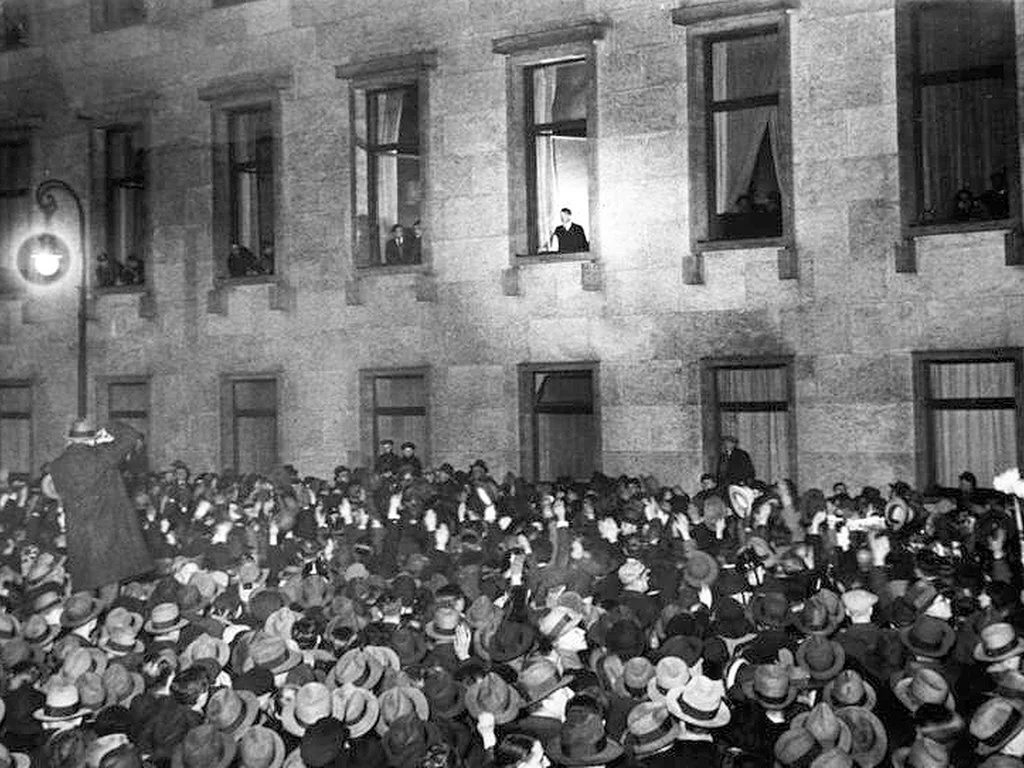
Hitler pitched in Berlin shortly after his appointment as Chancellor of Germany
The Final Days of Democracy
The period between Hitler's appointment as Chancellor and the complete Nazi takeover was a rapid dismantling of democracy:
Opponents were arrested or silenced.
The free press was gradually gagged through censorship and intimidation.
Civil liberties were curtailed in the name of "national security".
The Reichstag was sidelined as Hitler ruled by decree.
Many Germans, even those who hadn't voted Nazi, hoped Hitler would bring stability and an end to the political violence that had been plaguing the country. Few realised how fast and how far the Nazis would tear down Germany's democratic institutions.
The Reichstag Fire: Democracy's Death Blow
On February 27, 1933, less than a month after Hitler became Chancellor, the Reichstag building went up in flames. The Nazis quickly blamed the communists and used the fire as an excuse to suspend civil liberties and crush the opposition. A young Dutch communist, Marinus van der Lubbe, was arrested at the scene, but many historians believe the Nazis themselves were behind the arson.

Reichstag on fire during the night of February 27/28, 1933
The day after the fire, President Paul von Hindenburg signed the Reichstag Fire Decree, which suspended most civil liberties in Germany, including freedom of speech, freedom of the press and the right to assemble. This was the green light for the mass arrests of communists, social democrats and other Nazi opponents.
The Enabling Act followed shortly after and gave Hitler absolute power, the end of German democracy. The Weimar Republic was dead, and the Third Reich had begun.
See the aftermath: Our tour includes a visit to the rebuilt Reichstag, where you'll learn how this act of arson became a catalyst for Germany's slide into tyranny. Stand in the modern Bundestag and consider the fragility of democratic institutions.
The Debate Continues
The actual cause of the Reichstag fire is still debated among historians. The Nazi regime claimed it was the work of communist agitators; many scholars believe it was a false flag operation by the Nazis themselves. Key points of contention:
The speed of the Nazi reaction with prepared legislation.
Inconsistencies in the official version of van der Lubbe's actions.
SA men were seen entering the building before the fire.
Whatever the truth behind the fire, the Nazis used it to their advantage and crush the opposition.
Berlin: Capital of Nazi Germany
As the Nazis took power, Berlin changed. Symbols of the new regime appeared everywhere:
The swastika flag flew from government buildings and private homes.
Jewish-owned businesses were boycotted and vandalised.
Book burnings in the Opernplatz (now Bebelplatz) destroyed "un-German" literature.
The Olympic Stadium was built for the 1936 Games, a propaganda showcase for Nazi Germany.
Our tour takes you to these locations and helps you see the physical and psychological transformation of Berlin under Nazi rule.

SA men standing outside Jewish businesses to intimidate customers

Vandalism of a Jewish owned business
The Persecution Begins
As the Nazis consolidated their power, Berlin became a city of fear for many of its inhabitants. The vibrant Jewish community, which had contributed so much to the city's cultural and intellectual life, was increasingly marginalised and persecuted:
April 1, 1933, the Nazis organised a boycott of Jewish-owned businesses, with SA men standing outside shops to intimidate customers.
The "Law for the Restoration of the Professional Civil Service" on April 7, 1933, expelled Jews from government jobs.
The Nuremberg Laws of 1935 stripped Jews of their citizenship and banned marriages between Jews and people of German or related blood.
Our tour visits key locations in Berlin's Jewish history, including the site of the Great Synagogue on Oranienburger Straße, which was damaged during Kristallnacht in 1938.
The Human Cost
The Nazi persecution of Jews and other "undesirables" had a devastating effect on Berlin's social fabric:
Families were split as some members fled abroad while others stayed.
Long-standing friendships ended as non-Jews distanced themselves from their Jewish neighbours.
Talented professionals, artists and scientists were forced out of their jobs, a brain drain.
The city's cultural life was impoverished as Jewish contributions were erased or suppressed.
Our tour brings these human stories to life and helps you understand the personal tragedy behind the history.
Berlin's Cultural Revolution
The Nazis didn't just want to change the political landscape of Berlin; they also wanted to reshape its cultural life. A rigid, state-controlled cultural policy replaced the cosmopolitan, free-spirited Berlin of the Weimar years:
The Reichskulturkammer (Reich Chamber of Culture) was established to control every aspect of cultural life.
"Degenerate art" exhibitions were held to mock and stigmatise modern art.
Jazz and swing music was denounced as "Negro music" and banned.
The Underground
Despite the oppressive climate, there was still resistance in Berlin's cultural scene:
Some jazz musicians played in secret clubs.
Artists developed codes to express dissent in their work.
Writers and intellectuals met in private homes to discuss banned books and ideas.
These acts of cultural resistance may have been small, but they kept the flame of free expression alive during the darkest of times.
The Road to World War II
As Berlin became the capital of the Third Reich, it also became the hub of Nazi aggression:

Young SS recruits
The Wehrmacht High Command was based in Berlin, planning the military campaigns that would send Europe to war.
The invasion of the Soviet Union in 1941 marked a new level of Nazi Germany's war of annihilation in Eastern Europe.
The Wannsee Conference in 1942 in a villa on the outskirts of Berlin formalised the plans for the "Final Solution".
Our tour shows how Berlin became the hub of a regime that would soon threaten the world.
Military Berlin
Germany's rearmament in breach of the Treaty of Versailles was a central part of Nazi policy. Berlin was at the heart of this process:

Model of Germania. This new city hides it’s militarisation in plain sight
Secret weapons research was carried out in labs across the city.
Factories were converted for military production.
The city's infrastructure was upgraded for rapid mobilisation.
All this was hidden in plain sight and set the stage for the war to come.
Conclusion
The rise of the Third Reich in Berlin is a sobering reminder of how fragile democracy is. By visiting these sites and understanding the complexities that led to Nazi rule, we can learn valuable lessons to prevent this from ever happening again.
Berlin from 1926 to 1933 is not just a story of politics and street violence. It's a warning about economic desperation, the seduction of simple solutions to complex problems and complacency in the face of extremism.
Join our "Rise of the Third Reich" tour, walk in the footsteps of history, and experience this critical period like never before. Our expert guides will bring the past to life and show you how a democracy can fall to extremism. You'll see how individual and institutional decisions can shape the fate of a nation.
Remembering
As we visit the dark parts of Berlin's history, we are reminded of the importance of remembrance and education:
The Memorial to the Murdered Jews of Europe near the Brandenburg Gate is a place for contemplation on the Holocaust
The Topography of Terror on the site of the former SS and Gestapo headquarters has in-depth exhibitions on Nazi crimes
The German Resistance Memorial Centre is for those who risked their lives to resist the Nazi regime
All these and many more sites across Berlin are a warning of the dangers of hatred and the need to stand up for democracy and human rights.

Why did Germans vote for Hitler? Examining the factors behind the Nazi rise to power
Explore the reasons behind the Nazi Party's rise to power in 1930s Germany.
The rise of Adolf Hitler and the Nazi Party to power in Germany in the early 1930s is one of the most consequential and perplexing events in modern history. It's a story that continues to fascinate and horrify us in equal measure. How did a fringe extremist party, led by a failed artist with a history of violence and a radical ideology, come to win over a third of the vote in a democratic system and gain control of a highly developed, industrialised nation?
The answer is not as simple as many assume.

The new Reichskanzler Hitler addresses the German nation. 01.02.1933
In this post, we'll dive into the complex web of factors that led millions of Germans to cast their vote for Hitler and the Nazi Party. We'll look beyond the standard explanations and delve into the deeper underlying causes. We'll examine the Nazis' broad appeal across different social classes, from the working class to the middle class and even some elements of the aristocracy. We'll consider the devastating impact of the Great Depression on German society and how it created fertile ground for extremist ideologies to take root. And we'll analyse the failures of the mainstream political parties to counter the Nazis' rise effectively and offer a compelling alternative vision for Germany's future.
Through this exploration, we'll gain a more nuanced understanding of how a democratic system can be subverted from within by a determined and ruthless minority. We'll see how economic crisis, political instability, and a sense of national humiliation can create the conditions for authoritarianism to flourish. And we'll be reminded of the fragility of democracy and the importance of vigilance in defending it against those who would seek to destroy it.
So join me on this journey into one of the darkest chapters of the 20th century. Together, we'll unravel the mystery of Hitler's rise to power and draw lessons that are still relevant today as we face new challenges to democratic norms and institutions around the world.
Explanation of the "protest vote" and its limitations.
Many historians have characterised the Nazi electoral surge, particularly in the September 1930 election, where they jumped from 12 to 107 seats in the Reichstag, as a "catch-all protest" against the Weimar Republic's failures. However, this explanation, while not entirely without merit, is ultimately unsatisfyingly vague and fails to fully capture the complex factors that drove voters to embrace the Nazi Party.
As historian Richard Evans notes in his analysis of this period:
"Voters were not looking for anything very concrete from the Nazi Party in 1930, they were instead protesting against the failure of the Weimar Republic. The vagueness of the Nazi program, its symbolic mixture of old and new, its eclectic, often inconsistent character, to a large extent allowed people to read into it what they wanted to and edit out anything they might have found disturbing."
While Evans' observation astutely highlights the Nazis' ideological flexibility and the general dissatisfaction with the status quo, it doesn't adequately explain why voters specifically gravitated towards the Nazi Party over the numerous other opposition parties that existed at the time.

The Kapp Putsch, an attempted coup 1920, demonstrations the fragility of early democracy
If Nazi policies were indeed so nebulous and voters were looking to register their discontent, they theoretically could have thrown their support behind any number of alternatives, from the Communist Party to the German National People's Party.
The "protest vote" explanation, while capturing a particular aspect of the zeitgeist, is ultimately insufficient on its own. It fails to account for the specific appeal of Nazi messaging and the more profound anxieties and aspirations that the party was able to tap into. There had to be more concrete reasons why voters were drawn to the Nazis in particular, beyond a general sense of frustration with the Weimar Republic's shortcomings.
To fully understand the Nazi electoral breakthrough, we need to examine the interplay of economic, social, and cultural factors that made their message resonate with specific segments of the German population. This requires a more nuanced exploration of the Nazis' campaign strategies, their ability to capitalise on existing prejudices and fears, and the way they positioned themselves as a dynamic force for change in a time of uncertainty.
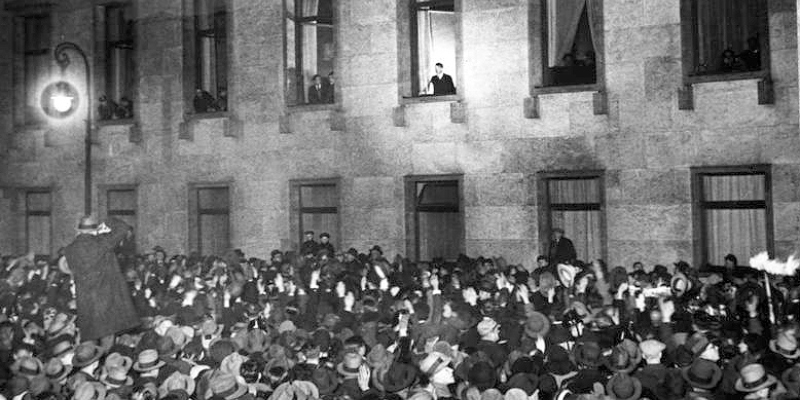
Hitler address a cheering crowd following his appointment as Chancellor
For example, the Nazis were able to exploit the economic anxieties of the middle class, who had been hit hard by the Great Depression and feared a further decline in their status. The party's promise to restore German greatness and protect traditional values appealed to those who felt left behind by the rapid social changes of the 1920s. Additionally, the Nazis' aggressive anti-Semitism and scapegoating of minority groups provided a convenient target for people's anger and frustration.
Moreover, the Nazis proved adept at tailoring their message to different audiences, emphasising various aspects of their platform depending on the crowd. In rural areas, they played up their support for farmers and promised to protect them from the encroachment of big business. In urban centres, they stressed their commitment to law and order and vowed to crack down on crime and moral decay. This chameleon-like quality allowed the Nazis to broaden their appeal and attract voters from diverse backgrounds.
It's also important to consider the role of propaganda and political theatre in the Nazis' rise. Hitler and his followers were masters of spectacle, staging elaborate rallies and marches that created a sense of excitement and momentum around their movement. They used the latest technologies, such as radio and film, to spread their message far and wide and create an aura of inevitability about their ultimate triumph.
While the "protest vote" may have been one component of the Nazi surge, it is far from the whole story. To truly grasp this pivotal moment in history, we must delve deeper into the complexities of Weimar Germany and the specific conditions that allowed the Nazi Party to emerge as a formidable political force. Only by examining the full range of factors at play can we understand how a fringe party with extremist views was able to capture the imagination of millions and ultimately seize power in one of Europe's most advanced nations.
The Nazis as the alternative to unpopular "hunger policies."
The onset of the Great Depression following the 1929 Wall Street Crash created mass unemployment and a sense of crisis in Germany. The economic devastation was unprecedented. Millions lost their jobs, businesses shuttered, and poverty skyrocketed. Amid this turmoil, the centrist government of Chancellor Heinrich Brüning responded with harsh austerity policies - drastically cutting government spending, wages, and social services.

Long lines at the social welfare office
These were deeply unpopular "hunger policies" that seemed to offer no hope of recovery to the suffering masses. The cutbacks only exacerbated the economic misery and fueled resentment among the populace. With no relief in sight, desperation and anger festered.
In this context of despair and disillusionment, many voters turned to radical alternatives in search of solutions. The Communist Party (KPD) saw its support among unemployed workers rise as it promised a workers' revolution to overthrow the capitalist system blamed for the crisis.
For the middle classes, property owners, and those fearing a Bolshevik-style communist uprising, the Nazis emerged as the more palatable option for change. The Nazis railed against both capitalism and communism, instead promoting a nationalist and racist ideology that scapegoated Jews and other minorities.
As historian Thomas Childers explains:
"The Nazis were able to gain support across social classes - workers, farmers, the middle-class, first-time voters. This confounded historians as the Nazis didn't fit the typical 'bourgeois' or 'working-class' party model. Their broad appeal is described as puzzling."
The Nazis' ability to draw voters from diverse backgrounds set them apart. Their message and rhetoric adapted to appeal to the grievances and fears of different segments of German society. To the working class, they promised jobs and a restoration of German greatness. To the middle class, they pledged to protect their property and status from a communist takeover. And to conservative elites, they vowed to crush leftist forces and restore order.

Hungry Germans buy potato’s with worthless currency
This ideological flexibility, combined with Hitler's charismatic leadership and the Nazis' powerful propaganda machine, allowed the party to broaden its base and present itself as the only force capable of saving Germany from economic ruin and political chaos. The fact that they could gain traction during the immense crisis and garner support that transcended class lines was a critical factor in their rise to power, even as their true intentions remained shrouded.
Hitler's charismatic leadership and oratory skills
Adolf Hitler's powerful oratory and mesmerising public speaking style played a crucial role in the rise of the Nazi Party. His speeches, delivered with passion and conviction, captivated audiences and drew in followers from all walks of life. Hitler had a keen understanding of crowd psychology and knew how to tap into the emotions and grievances of the German people. He masterfully exploited their fears, resentments, and desires, presenting himself as the one man who could solve all of Germany's problems.
In his speeches, Hitler portrayed himself as a strong, decisive leader who could restore Germany to its former glory. He promised to tear up the Treaty of Versailles, which many Germans resented as a humiliation, and to make Germany great again. Hitler's fiery rhetoric and ability to connect with his audience on an emotional level made him appear as a saviour figure, a man of destiny who could lead Germany out of crisis and into a bright new future.

Hitler speaking at a Bavarian Beerhall, 1924
Hitler's speeches were filled with grandiose promises and sweeping visions of a reborn Germany. He spoke of the need for national unity, the importance of racial purity, and the threat posed by external enemies such as Jews and communists. Hitler's words tapped into deep-seated feelings of anger, frustration, and wounded pride among the German people, who had suffered greatly in the aftermath of World War I and the economic turmoil that followed.
Hitler's charisma and stage presence were undeniable. He carefully cultivated an image of strength and power, often staging grand entrances and speaking in front of massive crowds and elaborate backdrops. His rallies were spectacles of light and sound, designed to evoke a sense of awe and to whip the crowd into a frenzy of enthusiasm. Hitler's body language, gestures and facial expressions were all carefully choreographed to reinforce his message and to project an aura of invincibility.
Many who attended Hitler's rallies described feeling swept up in the moment, caught in the spell of his words and the collective energy of the crowd. They spoke of a sense of euphoria, of being part of something greater than themselves. Hitler's speeches created a powerful sense of unity and purpose among his followers, binding them together in a shared sense of destiny and mission.

1932 speech at the Berlin Lustgarten
Through his speeches, Hitler was able to paint a compelling vision of a resurgent Germany, united under his leadership and restored to its rightful place as a world power. He promised to undo the humiliations of the past, to crush Germany's enemies, and to create a new social order based on racial hierarchy and national solidarity. Hitler's charismatic persona and ability to inspire fanatical devotion in his followers were critical factors in the rise of the Nazi Party, allowing them to build a mass movement that would eventually propel them to power and plunge the world into war.
In the end, Hitler's oratory skills proved a double-edged sword. While they allowed him to rise to the heights of power and to command the loyalty of millions, they also led Germany down a path of destruction and genocide.
The failure of mainstream parties to adapt
The Weimar Republic's proportional representation system led to a fragmented parliament with many small parties, each vying for their interests rather than working together for the nation's greater good. By 1930, the major parties had become increasingly polarised and unable to address the pressing issues facing Germany effectively. The economic crisis, mass unemployment, and social unrest required bold, decisive action, but the mainstream parties seemed paralysed by indecision and internal divisions.

Propaganda posters 1932 elections
The Social Democrats (SPD), once seen as the champions of the working class, were now viewed by many as defenders of the failed status quo. They seemed out of touch with the harsh realities of the economic crisis and needed help to provide the bold leadership needed to steer the country back on course. The SPD had been the largest party in the Reichstag throughout most of the Weimar period, but their support was rapidly eroding as disillusioned voters turned to more radical alternatives.
On the other end of the spectrum, the Communists (KPD) were gaining support among the growing ranks of unemployed workers who felt abandoned. The KPD's radical rhetoric and promises of a socialist utopia appealed to those who had lost faith in the current system. Their fiery denunciations of capitalism and calls for a workers' revolution resonated with many who felt they had nothing left to lose.
While still a significant force, the Catholic Centre Party was limited mainly to Catholic regions and struggled to expand its appeal beyond its traditional base. This left it ill-equipped to address the broader national issues that cut across religious lines. The Centre Party had played a vital role in the Weimar Republic's early years but now became increasingly marginalised as voters gravitated towards more extreme options.
Nationalist parties like the DNVP, once a dominant force in German politics, were increasingly seen as out of touch and irrelevant in the face of the nation's new challenges. Their narrow focus on traditional values and nostalgia did little to address the urgent needs of the present. The DNVP's support was concentrated among older, more conservative voters, but they failed to connect with the younger generation, who were bearing the brunt of the crisis.

Mass protests calling for stability
Voters were increasingly disillusioned with these mainstream parties, seeing them as inadequate for the radical change needed to pull Germany out of its crisis. The SPD, in particular, was blamed for the 1923 hyperinflation crisis, which was seen (rightly or wrongly) as caused by their economic mismanagement rather than the crushing burden of WWI reparations. As the "establishment" party in power for much of the Weimar period, they bore the brunt of public discontent and lost support to more extreme alternatives on both the left and right.
The failure of the mainstream parties to adapt to the changing political landscape and offer compelling solutions to Germany's problems created a vacuum that radical fringe groups eagerly filled. On the far right, the Nazi Party began its meteoric rise, capitalising on public anger and promising to restore Germany to its former glory. On the far left, the KPD attracted those who dreamed of a Bolshevik-style revolution. Caught in the middle, the crumbling centre could not hold against the centrifugal forces tearing Weimar democracy apart. The stage was set for a battle between extremes, with the very future of Germany hanging in the balance.
The Nazi Party's youth appeal and indoctrination
One of the most insidious aspects of the Nazi Party's rise to power was its concerted effort to indoctrinate and mobilise German youth. The Nazis recognised that winning over the hearts and minds of the younger generation was crucial to ensuring the long-term success and sustainability of their movement. They understood that by shaping young Germans' beliefs, values, and loyalties, they could create a deep reservoir of support that would continue to nourish their regime for decades to come. To this end, they established a network of youth organisations designed to instil Nazi ideology, foster unquestioning loyalty to Hitler, and prepare young Germans for their future roles as soldiers, mothers, and leaders in the Third Reich.
The Hitler Youth (Hitlerjugend) for boys and the League of German Girls (Bund Deutscher Mädel) for girls were the most prominent of these organisations. Through a carefully orchestrated combination of outdoor activities, sports, camping trips, and political education, these groups aimed to mould young Germans into perfect physical and ideological specimens of the so-called "Aryan race." The Nazis placed a strong emphasis on physical fitness, discipline, and camaraderie, creating a seductive atmosphere of purpose and belonging that proved highly appealing to many youth, particularly in the context of the economic hardship and uncertainty of the Weimar years.

Boys from the Hitler Youth

German girls from the Bund Deutscher Mädel
The activities and rituals of these organisations were deliberately designed to be exciting, emotionally charged, and all-consuming. Young people were swept up in a constant whirlwind of marches, rallies, songfests, and bonfires, all infused with the intoxicating symbolism and pageantry of the Nazi movement. At the same time, they were subjected to a relentless barrage of propaganda that glorified Hitler, demonised Jews and other "enemies," and painted a utopian vision of a resurgent, racially pure Germany. Through this potent mixture of fun, friendship, and fanaticism, the Nazis succeeded in forging intense bonds of loyalty and a powerful sense of collective identity among German youth.
By 1936, membership in the Hitler Youth was made compulsory for all eligible Germans between the ages of 10 and 18. This meant that virtually an entire generation underwent thorough Nazi indoctrination during their formative years, often to the exclusion of other influences such as family, church, or alternative political viewpoints. The long-term impact of this early ideological conditioning cannot be overstated. It produced a cohort of fanatically devoted followers who would go on to fight and die for Hitler's twisted vision while also perpetuating Nazi beliefs and structures throughout German society for years to come.
The Nazis' insidious targeting of youth was a critical factor in the regime's ability to consolidate its power and carry out its atrocities with disturbingly widespread collaboration and support. By capturing the idealism, energy, and impressionability of young people, they built a grassroots movement that sustained the Third Reich through its darkest chapters. The tragic legacy of this systematic indoctrination is a sobering reminder of the vulnerability of youth to extremist ideologies and the vital importance of nurturing critical thinking and diversity of opinion in the education and upbringing of each new generation.
The Nazis' deliberate vagueness and concrete promises
Into this void of political uncertainty and economic turmoil stepped the Nazis with their "catch-all" appeal that seemed to offer something for everyone. As historian A. J. Nicholls astutely notes, the actual policies put forth by the Nazi party were always
"deliberately vague and always changing."
This strategic ambiguity allowed Adolf Hitler to announce sweeping promises in his grandiose 25-point program and then freely contradict or modify them whenever it was politically convenient. The malleability of the Nazi platform allowed voters from all walks of life to project their own desires, grievances, and aspirations onto the party's rhetoric.

The Nazis masterfully exploited the desperation and disillusionment of the German people, who were reeling from the humiliation of World War I, the harsh terms of the Versailles Treaty, and the economic devastation of hyperinflation and the Great Depression. Into this maelstrom of misery and resentment, the Nazis cast themselves as saviours who would restore Germany to its former glory.
At the same time, amidst all the hazy sloganeering, the Nazis did make some very concrete promises that deeply resonated with the anxious and embittered public mood of the time:
Unifying all ethnic Germans scattered across Europe into a greater German Reich
Tearing up the universally hated Treaty of Versailles that had humiliated Germany
Seizing "living space" (Lebensraum) for German settlers in Eastern Europe
Removing Jews and other non-Germans from German economic and cultural life
Establishing a strong, authoritarian state to restore order and national pride
Nationalising big business and sharing corporate profits with German workers
These specific pledges tapped into the deep well of anger, fear, and wounded pride that pervaded German society in the wake of World War I and the economic chaos that followed. By promising to avenge Germany's humiliation, restore its territorial losses, and punish the alleged internal enemies who had "stabbed it in the back," the Nazis offered a seductive vision of national redemption.
This potent mix of hazy emotional appeals to nationalism and tangible policy goals aimed at specific grievances, all backed by the Nazis' dynamic, modern campaigning style, allowed them to attract support from across the social spectrum, from unemployed workers to wealthy industrialists.
As renowned historian Richard Evans explains:
"The Nazis gained their most spectacular success in the September of 1930 election where they went from 12 seats in the Reichstag to 107. The Nazis managed to reach parts of the working class that the traditional left-wing parties like the Social Democrats and Communists had failed to reach."
The Nazis' ability to attract such a broad coalition of supporters speaks to their skill at telling different groups what they wanted to hear. To the working class, they promised jobs, economic security, and a share of the national wealth. To the middle class, they pledged to restore stability, order, and traditional values. And to the elites, they vowed to crush communism, keep the masses in line, and pursue an aggressive foreign policy.
So while the Nazis never won an outright majority, their broad "big tent" appeal, combined with the fragmentation and paralysis of the other parties, allowed them to become the largest party in the Reichstag. From that position of strength, Hitler could outmanoeuvre his opponents and seize total power. The Nazis' rise was abetted by their cynical yet seductive campaign strategy of promising all things to all people. It was a strategy that preyed on the desperation of a nation in crisis and the willingness of people to embrace a messianic leader who promised them salvation, no matter the cost.
The Nazis as the "legal" revolutionary alternative
For many Germans in the tumultuous years of the Weimar Republic, voting for the Nazi Party was seen as a way to register their strong opposition to the status quo without having to resort to outright revolution or violence.
The Nazis shrewdly positioned themselves as offering a "legal" path to sweeping change, which helped allay fears among the populace of a Russian-style civil war breaking out in Germany. Unlike the Communist Party of Germany (KPD), the Nazis actively participated in elections. They worked within the existing political system to gain power, even as they railed against the ineffectiveness and decadence of that very system.
This approach allowed the Nazis to present themselves as a safer, more controlled radical alternative to the KPD or other extremist groups. They skillfully appealed to people's desire for meaningful change and their deep sense of injustice at how Germany had been treated in the aftermath of World War I while still working within the confines of the democratic system.

Hitler along with President Hindenburg after Hitler’s appointment 1933
The Nazis capitalised on the widespread disillusionment and anger felt by many Germans in the wake of the Treaty of Versailles, which had saddled the country with crippling war reparations and territorial losses. They promised to restore Germany to its former greatness and to stand up to the perceived injustices imposed by the victorious Allied powers.
At the same time, the Nazis were careful to distance themselves from the more radical elements of the far right, such as the paramilitary Freikorps units that had been involved in violent clashes with left-wing groups. By presenting themselves as a legitimate political party working within the system, the Nazis were able to attract support from a broader cross-section of German society, including members of the middle class, industrialists, and even some former liberals who had become disillusioned with the Weimar Republic.
This veneer of legality and respectability was a critical factor in the Nazi Party's growing popularity and electoral success. In the 1932 elections, the Nazis became the largest party in the Reichstag, although they fell short of an outright majority. This put them in a solid position to demand a leading role in the government, which they eventually achieved when Hitler was appointed Chancellor in January 1933.
However, it was only later, once the Nazis had consolidated their hold on the reins of government, that they would reveal their true dictatorial intentions. The legal revolutionary path had been a means to an end, a way to gain power through ostensibly democratic means. Once in power, the Nazis quickly moved to dismantle the institutions of the Weimar Republic and establish a totalitarian one-party state, crushing all opposition and ushering in the darkest chapter in Germany's history.
The Nazis' use of the "legal" revolutionary approach was a crucial factor in their rise to power. They gained a foothold in the political system by presenting themselves as a legitimate alternative to the status quo. They attracted support from a wide range of Germans desperate for change. However, this was ultimately a cynical ploy, a way to gain power through the very system they intended to destroy.
The Nazis' Paramilitary Tactics
While the Nazis presented a "legal" face in their pursuit of political power, they also relied heavily on paramilitary violence and intimidation to suppress opposition. The SA (Sturmabteilung), also known as the "brownshirts," served as the party's private army. They disrupted meetings of rival parties, engaged in street brawls, and generally created an atmosphere of fear and chaos. The SA was instrumental in the Nazis' rise to power, using force and threats to silence dissent and demonstrate the supposed strength of the Nazi movement.

SA member pictured along side a Berlin police officer.
As the Nazis gained seats in parliament, the SA's violence escalated to alarming levels. They staged mass rallies where uniformed stormtroopers marched in formation, portraying an image of discipline and strength. These displays were carefully choreographed to inspire awe and project an aura of certainty around the Nazis' ascent. Behind the scenes, however, the SA brutally attacked communists, socialists, trade unionists, and anyone else perceived as an enemy of the Nazi movement. They assaulted individuals, broke up gatherings, and made it clear that resistance to the Nazis would be met with savage retribution. This campaign of intimidation played a crucial role in the Nazis' rise, cowing opposition and demonstrating the futility of resistance.
Once Hitler became Chancellor in 1933, the SA's reign of terror intensified to an unprecedented degree. Emboldened by the state's backing, they arrested political opponents, ransacked union offices, and established makeshift concentration camps for "enemies of the state." The SA acted as the vanguard of the Nazi revolution, using violence to eliminate any potential threats to the new regime. This paramilitary violence paved the way for the destruction of democracy and the imposition of totalitarian rule. With the SA as his blunt instrument, Hitler was able to consolidate his power and transform Germany into a one-party dictatorship.
The threat of force had always backstopped the Nazis' "legal" revolution. The SA's actions made it clear that those who opposed the Nazis would pay a steep price. By creating an atmosphere of pervasive fear and demonstrating the regime's willingness to use violence, the SA helped the Nazis maintain their grip on power. Their brutal methods foreshadowed the terror and genocide that would characterise the Nazi regime in the years to come. The SA's role in the Nazis' rise highlights the fragility of democracy and the dangers of allowing paramilitary violence to go unchecked.
Conclusion: The dangers of desperation voting
The story of the Nazis' rise is not a simple one. It can't be reduced to a single cause like "protest voting" or "middle class panic." The reality is that in a time of crisis and desperation, a significant portion of the German electorate turned to the Nazis as the most dynamic and promising vehicle for their frustrated hopes and desires.
The Nazis exploited the weaknesses of the Weimar system and the failures of mainstream parties to build a broad coalition. They told different groups what they wanted to hear and made sweeping promises of change. Ultimately, enough voters were willing to overlook the dark side of Nazi ideology in favour of their message of national renewal.
Reflecting on this history, it's essential to recognise the danger of turning to extremists in times of hardship. The Nazis' rise reminds us of the need for democratic systems to deliver real solutions and maintain their legitimacy in the face of crisis. Desperate people can make desperate choices - and the results can be catastrophic.
To learn more about the rise and fall of the Nazis in Berlin, join us for our "Hitler's Berlin" tour. Our expert guides will take you to the key sites and provide in-depth historical context to help you understand this dark but critical chapter in history. Book your spot today.

The article was written by Matthew Menneke.
Matt is the founder and guide of 'On the Front Tours', offering military history tours in Berlin. Born in Melbourne, Australia, Matt's passion for history led him to serve in the Australian Army Reserve for eight years. With a degree in International Politics and a successful sales career, he discovered his love for guiding while working as a tour guide in Australia. Since moving to Berlin in 2015, Matt has combined his enthusiasm for history and guiding by creating immersive tours that bring the past to life for his guests.
The Rise of the Nazi Party
Hello and welcome to the On the Front blog, where we discuss all things WW2.
In this blog, I am going to answer what is probably the most frequently asked question I receive on my tours: How did the Nazi’s come to power?
Berlin in the 1920’s was a bustling cosmopolitan city. Described by Mark Twain as the Chicago of Europe. There was no indication that on a cold grey day in November 7, 1926 and the arrival of the then 29-year-old Joseph Goebbels would forever alter the course of History.
Arriving at Anhalter Bahnhof, Goebbels was tasked with the seemingly impossible target to win support for the National Socialist in the German Capital. By Goebbels own admission Berlin was “the reddest city in Europe besides Moscow” but, by 1933, a combination of political brilliances and the use of brutal street intimidation tactics saw the National Socialists succeed in winning the city.

Remains of Anhalter bahnhof
Potsdamer straße
Shortly after arriving Goebbels made his way to Potsdamer str 109, in the Berlin suburb of Teirgarten and the location of the Party Headquarters in the city. In 1926 the Nazi party was in a desperate state, with only 49,000 members across the country, the situation in Berlin was dyer with only a few hundred members. An official party report on Berlin office (October 1926) described the organisation as “self-destructive and beyond the point of repair”. The office location did not inspire confidence nick named the “opium den” by party members, the basement office reeked of stale beer, cigarettes and sweat.
Appalled by the sorry state of affairs Goebbels immediately got to work reforming the organisation. In a three-hour long speech at an event in the suburb of Spandau, he affirmed his position as regional party leader. He restructured party leadership by removing the “do-nothings” and appointed new section leaders himself. His strategy to win the city rested with the party’s ability to intimate their opponents and emphasised the use of propaganda.
By the end of the year, Goebbels tactics appeared to be working and the party was able to rent what Goebbels described as a more “appropriate office” in the neighbouring Lützow straße. In total the regional party office would relocate on a total of four occasions, each time to larger and more opulent spaces.
Goebbels wanted to show Hitler’s party in its true colours by combating the established left-wing communist KPD and Socialist SPD parties which together held a 52% majority in a full-frontal attack, in a strategy of provocation. The use of street violence to achieve political goals was not a new approach in Germany. In the early crisis years of the Weimar Republic, some 354 German politicians had been murdered by both left- and right-wing paramilitary groups.
With the help of the Sturmabteilung (SA) or brownshirts, Goebbels would turn the streets of Berlin into a violent labyrinth in a prelude of things to come. On the 11th of February 1927, Goebbels held a speech on the “collapse of the Bourgeois Class State” in the Pharussäle, a beautiful beer hall in the communist strong hold of Wedding. The building was unfortunately destroyed during the war.
Pharussäle beerhall
This provoked the communists, who got wind of the event, to storm the hall in an attempt to shut down the speech but the SA whose ranks were filled with young ideologist fought back. The violent brawl saw beer glasses, chairs and tables fly about the room and severely injured many people who attended that night. Despite the injuries it was a huge success for the Goebbels as the SA beat some 200 communists to a pulp and drove them from the hall.
There were reports that some of the most severely injured SA members were quickly bandaged up and brought on stage as heroes. This event would later be romanticised by Goebbels in his propaganda of the victorious struggles of the party in the early days.
Der Angriff
The use of these tactics though would eventually see the Nazi party banned in Berlin. In a creative effort to stay relevant Goebbels establish seemingly harmless groups such as bowling and swimming clubs under the motto “not dead, despite the ban”. The ban would later prove beneficial, with Goebbels establishing his newspaper “Der Angriff” (the attack), serving to show the party as oppressed by the establishment. The ban was lifted during the 1928 elections and Goebbels would see his first electoral success, winning 1.6% of the Berlin vote and 12 seats in the German parliament and from here their success would continue.
The Weimar Republic, Germany’s first democracy was reasonably stable, if only just holding on by its fingernails. This period can only be described as the beginning of Germany tinkering on the brink of civil war. Germany was dealing with hyperinflation as a result of economic mismanagement. The system would see its first proverbial nail in the coffin in late October 1929 in the onset of the Great Depression. Hitler was propelled to near prophet like status, as his previous years of preaching doom and gloom over the harsh conditions of the Versaille Treaty and Germany’s over reliance on foreign loans spelling ultimate economic disaster would come true.
Mass unemployment skyrocketed and the increasing potential for civil unrest balanced on a tinderbox. Lighting spot fires where they could, Goebbels railed against the established parties using his newspaper ‘Der Angrif’ which went from a weekly to daily publication. The majority of support for the Nazi Party in Berlin and indeed broader Germany came primary from the white-collar middle classes, who were especially concerned with social decline, the ever-increasing influence of communism and fear over a Bolshevik revolution.

Lustgarten, Berlin
In Berlin Goebbels, appealed to all unemployed and especially party members to open their homes and offer hot soup and solidarity, in an action he would call “Socialism of action”. It was for all intents and purposes a huge success and saw even the most die-hard of communist members flock to the National Socialist as party was seen as the only organisation to be having any real impact to improve the average Germans situation.

Geobbles speech, Lustgarten 1930
Popularity for the Nazi Party from these events would forever increase, soaring in early 1932 unemployment in Berlin hit 600,000. The Nazi’s held a rally of 80,000 people in the Berlin Lust Garten in a trial run of future events. Goebbels promised the “right to work” and a “socialist Germany that once again gives bread to its people”.
In the months leading to Germany’s last free and open election on the 6th of November 1932, Hitler would work harder than any other political candidate. He crisscrossed the country in an aeroplane, the first politician to use this modern technology in such a way. He would descend from the skies to awaiting crowds in their tens of thousands, promising a brighter future for everyone, even going as far as to promise a husband for every German girl in the Reich.
Goebbels mobilised as many brown shirts as possible to wave the Nazi swastika in the streets, hand out pamphlets and to drive around the streets with posters nailed to the sides of trucks in mobile billboards with speakers attached to ensure the Nazi party was first and foremost in the minds of the German voters.
Hitler at window of the Reichs Chancellory on inauguration, January 30, 1933
The election would see the Nazi’s become the No.1 party in Germany, winning 33.9% of the vote. Although not an outright majority, Hitler was able to form a coalition government known initially as the Reich Cabinet of National Salvation. Later the Hitler Cabinet with the German National People Party taking office on the 30th of January 1933.
It was through these tactics; the Nazi Party was democratically voted into office in Germany. In a future video/blog, I will go into detail on how Hitler would seize full control of the German parliament and become the Führer.
Thank you for reading and I’ll see you next time On the Front.
- Matt